
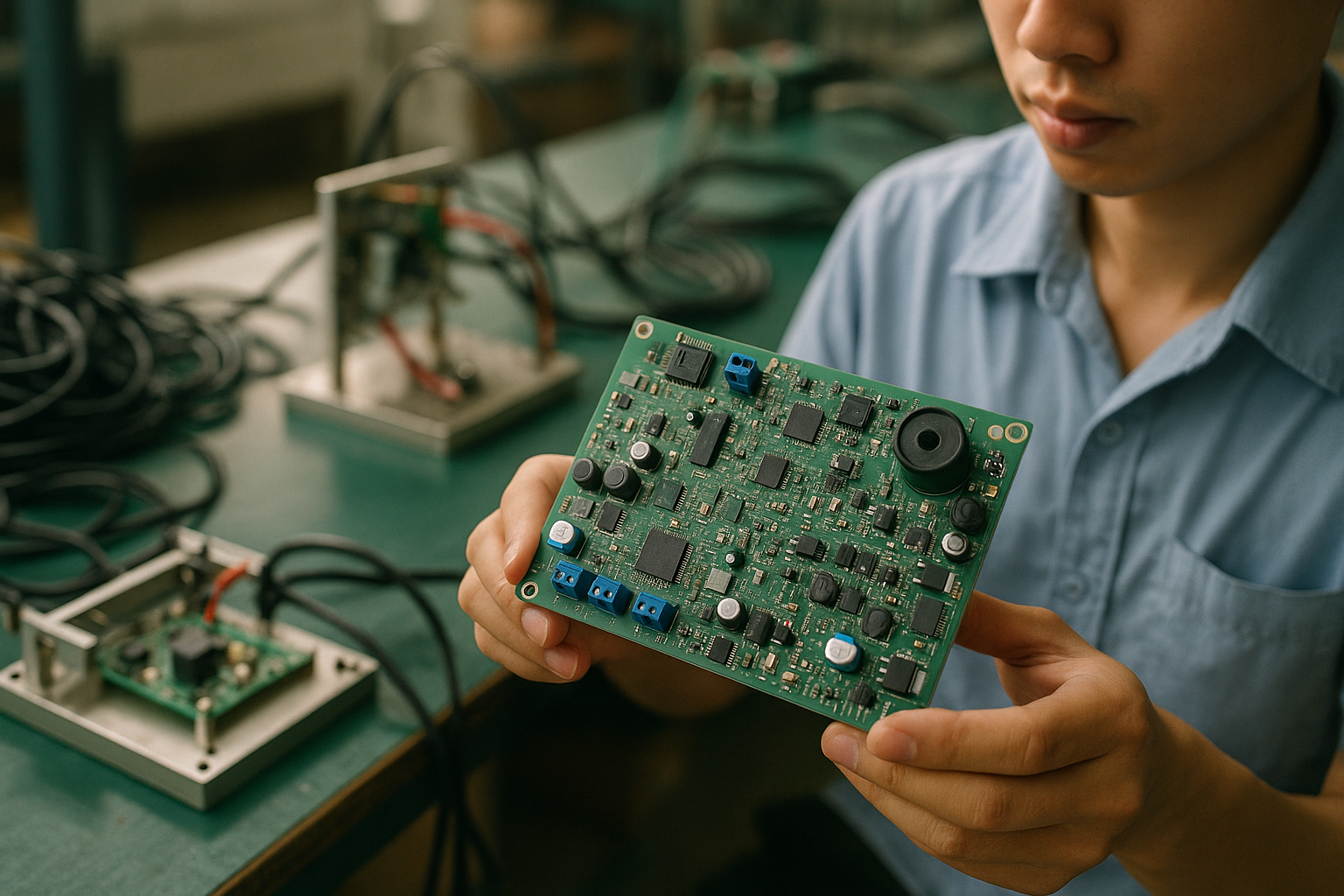
Sensor selection for IoT devices starts with one decision: what user outcome must the sensor deliver? Treat the choice as a product decision, not a technical puzzle. Use prototypes and production validation to prove the decision before the factory ramps.
What user outcome should drive my sensor choice?
Begin by describing the visible behaviour that makes the product useful. Is the sensor triggering a light, counting events, or showing a numeric reading customers act on? That outcome determines how accurate, fast and protected the sensor must be.
Write a simple acceptance rule the team can test on a prototype. For example, state whether a reading can be off by a fixed amount, or whether a feature must react within a specific number of seconds. A clear acceptance rule keeps development focused and makes supplier choices easier to evaluate.
What sensor selection for IoT devices approach works best: modules or discrete parts?
Ask which approach reaches your validated outcome fastest. Integrated modules bundle sensing elements and support electronics, which speeds prototyping and shortens time to a working demo. Discrete sensors give more control over placement, thermal path and signal conditioning, which matters when enclosure geometry or local heat sources influence readings.
Practical path: shortlist both when placement or enclosure details could change results. Use prototypes to compare an off-the-shelf module against a discrete sensor placed where it will sit in the final case. Let measured prototype results decide which approach moves to production validation.
How accurate does the sensor need to be?
Translate the product promise into a maximum tolerated error. If the sensor only needs to detect a threshold, coarse accuracy may be fine. If customers rely on the numeric value, pick sensors and signal chains that meet the tolerance and plan calibration steps you will validate in production.
Use small prototype runs to show the difference between options. Record the measured error against your acceptance rule and choose the option that reliably meets the user expectation when installed inside the finished enclosure.
How will sensor choice affect battery life and responsiveness?
Decide required response time and sampling frequency early, because these choices shape battery life and perceived speed. Some sensors offer low-power event or wake modes, others need steady sampling. Test prototypes under realistic usage to understand battery implications, and share those test results with your manufacturing partner.
If a feature feels slow during testing, work with your manufacturing partner to adjust sampling strategy or wake logic, and confirm those firmware and hardware decisions are locked into the production validation steps the factory will run. Ask the partner how they will measure power and responsiveness during pilot runs so accepted settings are repeated at scale.
Will the chosen sensor survive the product environment?
Decide where the product will live and what stresses it will face. Outdoors you will see moisture and temperature swings. In industrial settings expect dust and vibration. Design protection that matches those conditions and run targeted durability checks that replicate expected use.
When long-term drift matters, plan self-checks, periodic calibration or software correction. For formal environmental verification, plan vendor lab testing and document the acceptance criteria production will use. The IEC 60068 series describes standard environmental test procedures you can reference when defining those tests.
Which choice will customers notice in the field?
| Product outcome | Integrated module | Discrete sensor | Ruggedized option |
|---|---|---|---|
| Time to prototype | Predictable integration for fast proof of concept | Longer due to placement and support electronics design | Longer because of enclosure and protection design |
| Measurement quality | Good when published performance matches tolerance | Preferred when exact placement and signal conditioning matter | Can match quality while adding environmental protection |
| Durability | May need enclosure work to meet harsh conditions | Can be tailored with seals and barriers for expected stresses | Designed to resist moisture, dust, vibration and extremes |
How do we prove the sensor will work before production?
Sequence the work so issues are found early. Shortlist approaches that meet the product outcome, build prototypes that exercise real use, run those prototypes in field-like conditions, capture measurable differences, and finalise the validation steps production will run on every unit.
Document prototype findings, corrective actions, and the acceptance checks the factory will perform. Validate alternate supplier parts in prototypes and pilot runs, then add those acceptance tests to production so supplier substitutions do not change the customer experience.
How should I manage supplier substitutions during a product life?
Supplier substitution is common. Identify acceptable alternates early, validate them in prototypes and pilot runs, and document how a substitution affects user-visible behaviour or assembly steps. Agreed validation checks let production swap parts without changing the customer experience because performance is confirmed before parts reach the line.
FAQ
How accurate does a sensor need to be for an IoT product?
Accuracy should match the feature promise. Define the maximum error a user will tolerate, then select sensors whose specifications and prototype tests meet that threshold. Use prototypes to demonstrate the visible difference so stakeholders can accept or revise the tradeoff.
How do I approach sensor selection for my IoT product?
Start with the user outcome, shortlist sensing approaches that meet that outcome, and test them in prototypes that mimic real use. Evaluate accuracy, battery impact, response time and durability. Convert the winning approach into repeatable validation steps for production, shared with your manufacturing partner.
Can I start with a simpler sensor and evolve the feature later?
Yes. If hardware and software are designed for evolution, swapping sensors later can be predictable and avoid major rework. Plan upgrade paths early so evolution focuses on the user outcome and schedule, not unexpected integration work.
Ready to decide which sensing approach belongs in your product? Discuss your requirements, prototype needs or manufacturing plan with Futurezen so the product decision can be validated before production. See our services for how we run prototyping and validation that keeps launch risk low.