
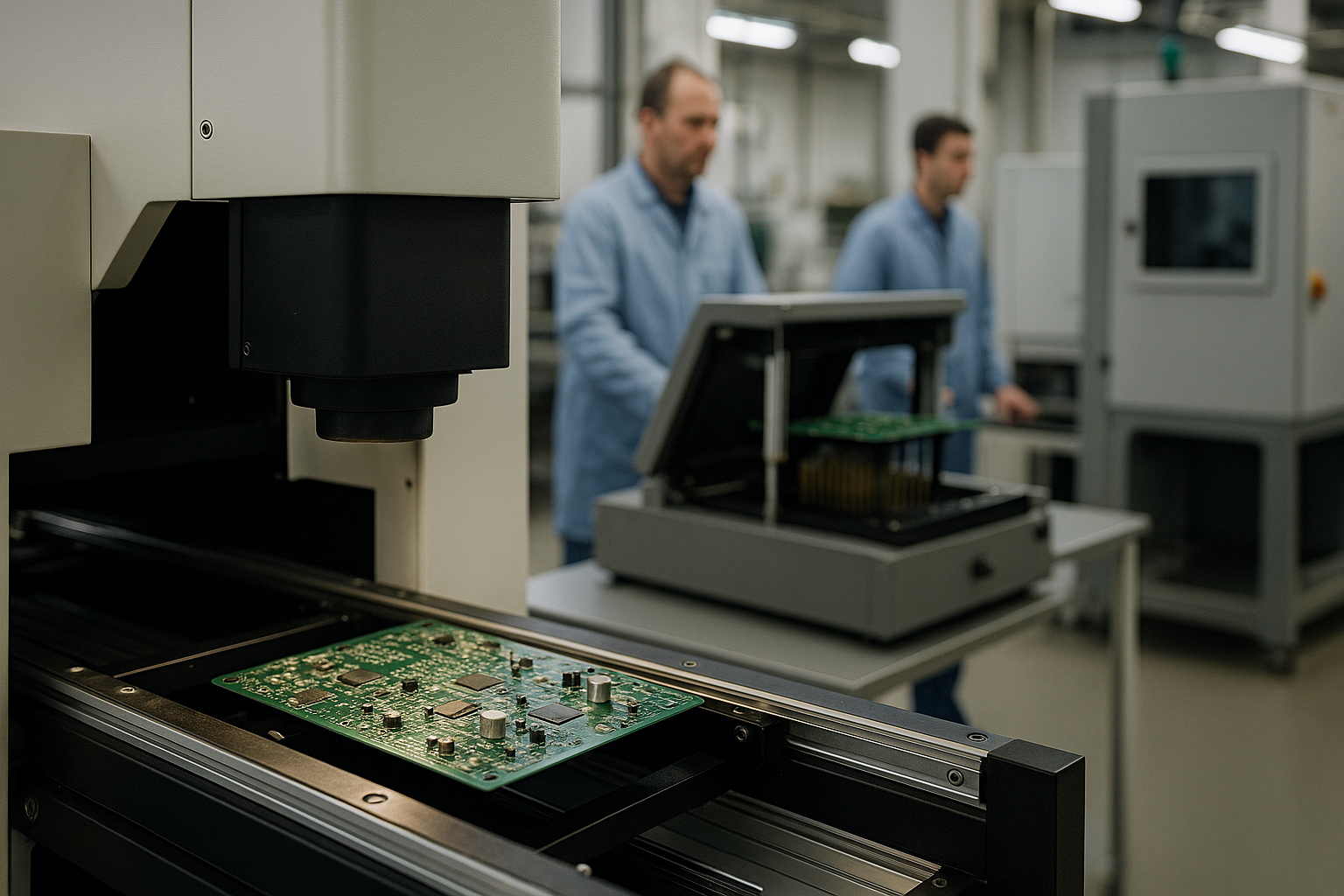
Futurezen tailors electronics assembly inspection to protect your launch
Futurezen tailors electronics assembly inspection to deliver the reliability your product needs without adding unnecessary process steps. Camera scans find visible problems, electrical probing verifies connections, and X-ray shows hidden solder joints. We assess your design, recommend the right combination, and execute these checks in-house as part of our manufacturing flow.
What does electronics assembly inspection catch?
We use three complementary inspection methods so each step gives useful evidence about the build. The goal is to find defects tied to specific assembly steps, so fixes are fast and repeatable.
Camera inspection, also called automated optical inspection or AOI
Our camera systems scan populated boards to find visible issues, such as missing or reversed parts, misalignment, and obvious solder bridges. Camera inspection is fast and provides broad, early coverage for most surface-mounted components.
Electrical probing, often called in-circuit test or ICT
Electrical probing makes controlled measurements on pins and nets to confirm connections and common component values. It detects open or shorted nets and many component faults that a camera cannot show, so we use it when connection confidence matters before functional power-up.
X-ray inspection
X-ray lets us see solder beneath packages and internal features a camera cannot access. We use X-ray to check hidden joints, such as under ball grid array packages, and to confirm the solder process on first builds or when joint evidence is ambiguous.
| Inspection method | What it catches | When we use it |
|---|---|---|
| Camera inspection (AOI) | Missing, reversed or visibly misaligned parts, and visible solder bridges | Applied broadly for fast coverage of visible assembly faults |
| Electrical probing (ICT) | Open or shorted connections and incorrect common component values | Added when connection coverage is important before power-on |
| X-ray inspection | Hidden solder joints, internal shorts and incomplete solder under large packages | Targeted for hidden-joint parts and early production samples |
When does Futurezen recommend X-ray inspection?
We recommend X-ray when the design includes hidden-pin packages, large packages where wetting cannot be assessed visually, or when first-build evidence suggests a joint issue. For pilot runs and first samples, we often include targeted X-ray so we can confirm the solder process before repeating the same assembly pattern across production.
How Futurezen decides the right inspection mix
We do the assessment for you. Our recommendation combines three practical inputs: the parts and package types, the first-sample results, and your reliability goals. That gives a clear plan that balances defect detection, schedule, and throughput.
- Parts and visibility, we check whether most components are visible from above. If they are, camera inspection will catch the majority of assembly mistakes.
- Hidden joints and complexity, we look for packages with hidden pins or dense routing. Those designs typically need targeted X-ray or extra electrical probing.
- Reliability goals and launch timing, we match inspection depth to your acceptance criteria and schedule. Early production often uses deeper coverage so we find and fix process issues before full ramp.
How we sequence inspection during first builds
Our usual sequence for first samples and pilot runs is designed to find the most likely faults early, and to keep troubleshooting focused.
- Camera scan to remove obvious placement and soldering faults right after reflow.
- Targeted electrical probing where net access and fixture design allow, to verify continuity and common component values.
- X-ray on selected boards or component families when hidden joints or intermittent solder concerns are likely.
This sequence balances early fault removal with deeper inspection where it adds value, and it keeps repair and rework local to the assembly step that introduced the fault.
How the inspection choices affect schedule and troubleshooting
Adding inspection adds time per board, and we always present the tradeoffs. More coverage reduces the chance defects reach functional test or the field, and often shortens total development time by preventing repeated debugging. We recommend the inspection depth that meets your reliability target while managing throughput for the launch phase.
What problems do these checks prevent after launch?
Camera inspection reduces simple placement and visible solder issues before the board reaches later tests. Electrical probing prevents powering boards with open or incorrect connections, which keeps failures linked to assembly rather than software. Targeted X-ray for first builds confirms the solder process for packages you cannot see, reducing intermittent field issues tied to hidden joints. Futurezen uses parts lists, first-sample evidence, and the stated reliability goals to decide where broad camera coverage is sufficient and where targeted electrical or X-ray checks are justified.
How Futurezen helps you get the right plan
Send prototype photos, your parts list, and a short note of your reliability goals. We will review the build, recommend a practical inspection plan, explain the tradeoffs in plain language, and execute the agreed checks in-house. Our role is to set the inspection so your launch quality is protected without unnecessary steps.
For industry context on assembly process expectations, see the IPC manufacturing standards at https://www.ipc.org.
FAQ
How does Futurezen decide which checks to use?
We review the parts list and prototype photos, identify package types and likely risk areas, and match inspection methods to those risks. The recommendation balances defect detection, production speed, and your stated reliability targets.
Will these checks replace final functional testing?
No. Camera, electrical, and X-ray checks focus on assembly and joint quality. Functional testing still verifies product behaviour under power and use. The inspection methods reduce manufacturing defects that would otherwise be found during functional test or in the field.
Do I need to specify inspection choices myself?
No. Give us the parts list, prototype photos, and your reliability goals. Futurezen will propose the inspection mix, explain schedule impacts, and implement the approved plan as part of our manufacturing service.
Next step
Discuss your manufacturing requirements, prototype or production plan, and reliability targets with Futurezen. Send prototype photos and the parts list so we can review the build and recommend the right combination of camera, electrical probing, and X-ray checks for your launch.
Futurezen editorial team