
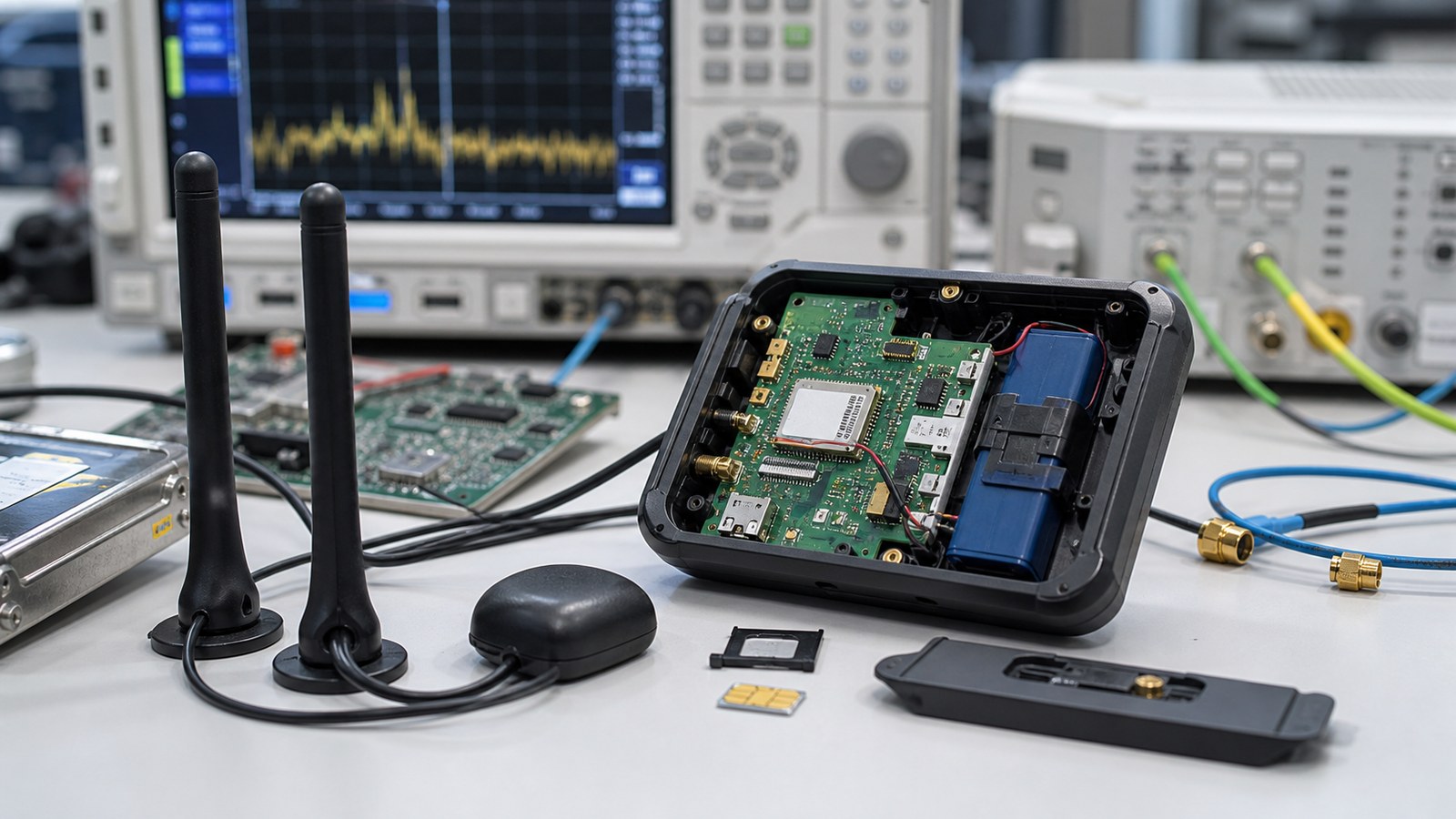
A 4G connected device development project usually gets into trouble before anyone notices. The module looks fine on the datasheet. The prototype connects in the lab. The first demo works. Then the product moves into an enclosure, ships to a different country, sees weak signal, wakes from sleep, retries a data session, and suddenly the problem is not “connectivity” anymore. It is power, antenna placement, firmware, SIM provisioning, certification, and production testing all colliding at once.
That is why cellular hardware should not start with the cheapest LTE module on a parts list. For IoT products, payment devices, smart terminals, field equipment, AI hardware, and industrial products, 4G can remove Wi-Fi setup and phone pairing. It can make the product feel ready out of the box. But only if the architecture is planned early enough.
4G Connected Device Development Starts With the Deployment, Not the Module
Most teams want to choose the module first because it feels like progress. In practice, the deployment decides the module. A device for one country, one carrier, and fixed indoor use is a different product from a device that must roam across regions, wake on battery, survive weak signal, and be provisioned before shipment.
Before choosing cellular hardware, define:
- Target countries and carriers
- Required LTE bands and roaming expectations
- Data volume and throughput requirements
- Battery life and peak current limits
- Indoor, outdoor, mobile, or fixed installation environment
- Whether the device needs voice, SMS, GNSS, or only data
- Whether users will install SIMs or the product should ship connected
- Certification, carrier approval, and factory test requirements
These answers affect the module, antenna, SIM/eSIM strategy, enclosure, PCB layout, power supply, firmware, test fixture, and launch timeline. If they are answered late, the cost is rarely limited to one component change.
Choosing LTE Cat 1, Cat 1 bis, LTE-M, NB-IoT, or Cat 4
The LTE category should match the job the device actually has to do. Bigger is not automatically better. Lower power is not automatically simpler. The wrong choice can create coverage issues, firmware complexity, certification delays, or a BOM that no longer fits the business case.
| Option | Best Fit | Main Tradeoff |
|---|---|---|
| LTE Cat 1 / Cat 1 bis | Payment devices, trackers, smart terminals, industrial devices, and moderate-data IoT products | Good 4G coverage, but power, antenna, and module cost still need careful control |
| LTE-M / NB-IoT | Low-data sensors, meters, and battery-focused IoT products where networks support it | Coverage, roaming, and carrier support vary sharply by region |
| LTE Cat 4 or higher | Devices needing higher throughput, video, gateway behavior, or richer terminals | Higher power draw, higher cost, and more thermal planning |
| 4G smart module | Android terminals, POS products, kiosks, displays, and AI-connected devices | Faster application development, but more platform dependency and unit cost |
For many connected devices, LTE Cat 1 or Cat 1 bis is a practical balance between coverage, cost, and data needs. For Android POS, display terminals, cameras, or AI-connected products, a smart module or higher-category module may be more realistic. The point is not to pick the most impressive module. The point is to pick the module that survives the product’s real operating life.
Module Selection Is a Lifecycle Decision
The module price is almost never the full cost. A low-cost module that creates certification gaps, firmware instability, poor documentation, supply uncertainty, or factory test problems can become the expensive choice.
During module selection, review:
- LTE bands required for each target market
- Existing regulatory certifications or carrier approvals
- Expected module lifecycle and supply availability
- Firmware stability, documentation, and supplier support
- GNSS, eSIM, USB, UART, audio, and other interface requirements
- Transmit-current peaks and power rail requirements
- Production-line test support for IMEI, SIM/eSIM, signal, and data sessions
In Shenzhen production planning, module availability can affect more than purchasing. A late module change may require PCB layout changes, antenna retuning, firmware edits, fixture updates, new sample builds, and fresh compliance review. That is the kind of delay that does not look serious in the first BOM meeting but becomes very real before EVT or pilot production.
Antenna and Enclosure Design Decide Real-World Reliability
A strong LTE module cannot rescue a bad antenna environment. Plastic thickness, metal parts, batteries, displays, speakers, board placement, user grip, and mounting orientation all influence signal quality. This is where a product can connect beautifully on an open bench and then disappoint inside its final enclosure.
Review these items before tooling:
- Antenna type and location
- Ground clearance and keep-out area
- Nearby battery, display, speaker, cable, metal, and PCB interference
- Handheld, wall-mounted, vehicle-mounted, or enclosed installation
- Expected product orientation during use
- Indoor, outdoor, and weak-signal field conditions
Antenna decisions should happen while the enclosure is still flexible. Once tooling is locked, RF fixes often become awkward: thicker housings, external antennas, layout compromises, or performance targets that have to be lowered.
Power Design for 4G Connected Products
4G modules draw short current bursts during registration, transmission, reconnection, and poor-signal operation. If the power path is weak, the device may reset, drop off the network, fail testing, or behave like a firmware problem when the real issue is electrical.
Plan for:
- Peak transmit current
- Battery voltage range
- Power rail stability
- Capacitor selection and placement
- Sleep and wake behavior
- Retry and reconnect logic
- Thermal behavior during long sessions or poor signal
For battery-powered devices, firmware architecture matters as much as hardware. Data batching, sleep timing, reconnect intervals, retries, and over-the-air updates should be designed together. Cloud dependency is not only a backend decision. It changes battery life, user experience, and field support.
SIM, eSIM, and Out-of-Box Activation
If users must open the product, insert a SIM, choose a data plan, enter APN settings, and troubleshoot network registration, a good product can feel broken before it gets used. For commercial devices, shipping with connectivity already prepared can reduce support tickets and improve first-use success.
Common approaches include:
- Physical SIM inserted during production
- Soldered eSIM / eUICC for remote provisioning
- Module with embedded SIM capability
- Regional SIM SKUs for different launch markets
- Managed IoT connectivity provider with activation workflow
The right choice depends on launch countries, who owns the data plan, how activation is handled, how replacements are supported, and whether profiles may need to change after shipment. For global products, SIM planning should happen before packaging and production flow are finalized, because IMEI/SIM pairing, labeling, activation records, and QA checks may all become part of the factory process.
Certification, Carrier Approval, and Field Testing
Cellular devices may need regulatory certifications, RF testing, safety review, module documentation, and carrier approval depending on the product and sales markets. CE, RoHS, FCC, and market-specific requirements should be mapped early. If the product is also a payment device, certification planning may need to connect with POS, EMVCo, PCI, and card-network requirements as well.
Lab testing is necessary, but it is not enough. A useful validation plan should include:
- Target-country SIMs or roaming profiles
- Weak-signal and indoor locations
- Network registration time
- Reconnect behavior after power loss or signal loss
- Data upload/download under realistic use
- Battery drain under normal and poor-signal conditions
- Firmware update behavior over cellular
- Factory test method for IMEI, SIM/eSIM, antenna, signal, and data session
Production test is the part many teams underestimate. Every unit leaving the factory needs a clear way to verify that the module, antenna, SIM/eSIM, and data session are working. Otherwise, the first real test happens after delivery, which is the most expensive place to find a cellular fault.
4G Connected Device Development Checklist
- Define countries, carriers, bands, and roaming needs before module selection.
- Choose LTE category based on data, power, coverage, certification, and cost requirements.
- Review module lifecycle, documentation, firmware stability, and factory test support.
- Plan antenna placement before enclosure tooling.
- Design the power path for cellular transmit peaks and reconnect behavior.
- Decide physical SIM, eSIM, embedded SIM, or managed connectivity early.
- Map CE, RoHS, FCC, carrier approval, and any payment certification requirements before mass production.
- Test in real field environments, not only in the lab.
- Create a production test process for module, antenna, SIM/eSIM, signal, and data.
How Emszen Can Help With 4G Connected Device Development
Emszen supports connected electronics product development and manufacturing from Shenzhen, China. For 4G connected products, the team can help review module selection, PCB and antenna constraints, enclosure and tooling considerations, SIM workflows, BOM optimization, certification planning, field testing, and production test design.
This is where early manufacturing input matters. A cellular product is not only an electronics design. It is a chain of decisions: module, antenna, enclosure, power, firmware, cloud behavior, SIM plan, certification path, QA process, packaging, and after-sales support. If one link is weak, the user simply sees a device that does not connect.
Planning a 4G Connected Product?
If you are trying to decide whether your module, antenna, SIM plan, and certification path are ready for production, that is exactly the conversation to have before tooling and mass production. Share your target countries, use case, prototype stage, and expected production volume.
FAQ
Which LTE category is best for an IoT device?
It depends on data rate, power target, coverage, country, carrier support, certification path, and cost. LTE Cat 1 or Cat 1 bis is often useful for moderate-data devices, while LTE-M or NB-IoT may fit low-data products where the required networks support them.
Can a device ship with a SIM already installed?
Yes. A device can ship with a physical SIM, eSIM/eUICC, embedded SIM option, or managed IoT connectivity plan. The best choice depends on deployment countries, activation workflow, ownership of data plans, support model, and factory provisioning process.
What should be tested before mass production of a 4G connected product?
Test module registration, antenna performance, weak-signal behavior, reconnect behavior, power peaks, battery drain, firmware updates, SIM/eSIM provisioning, target-country networks, and production-line connectivity checks.