
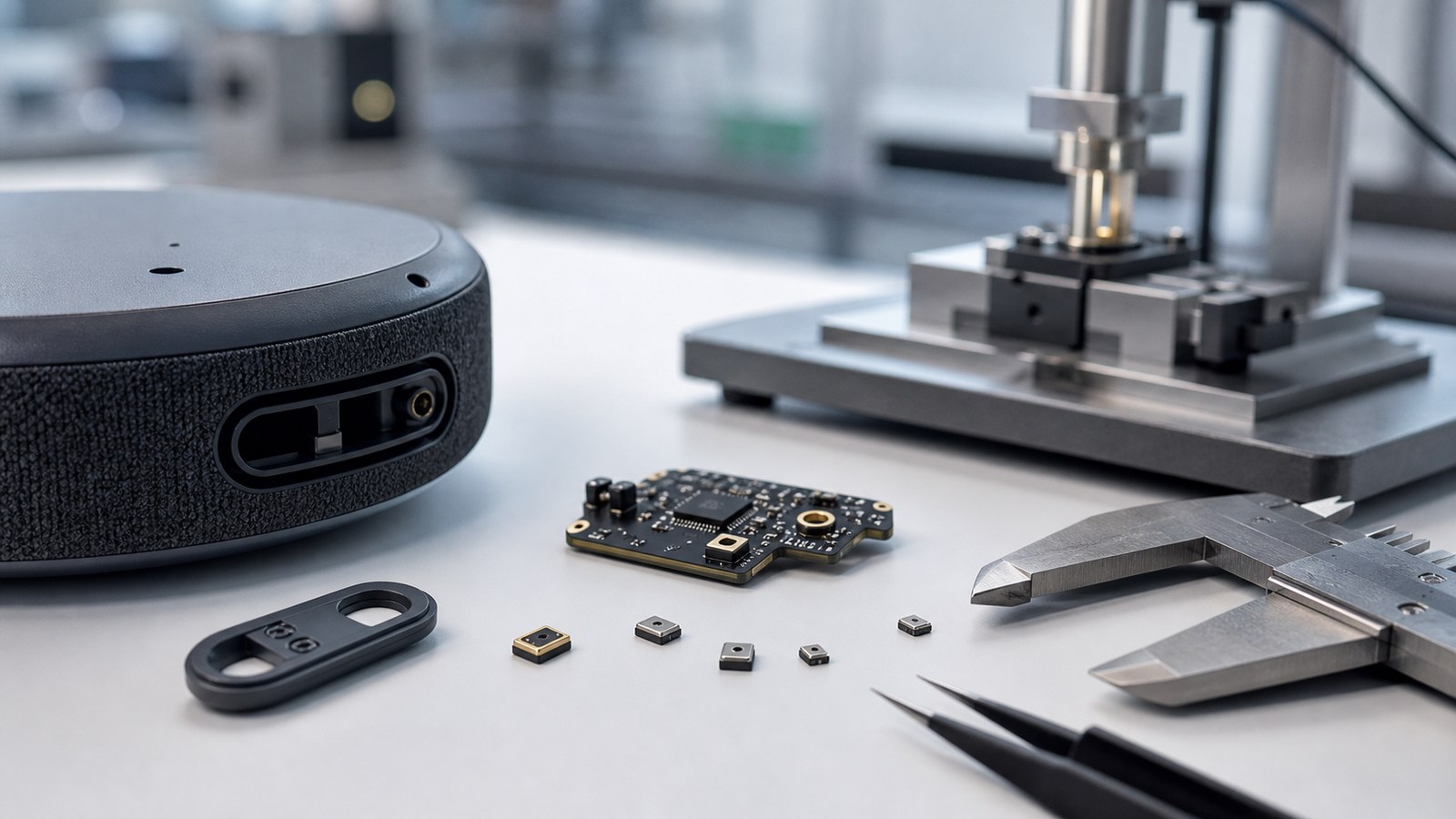
MEMS Microphones for Connected Devices: Selection, Placement, and Manufacturing Tradeoffs
Choosing the right MEMS microphone for a connected device affects voice quality, BOM cost, test strategy, and certification. This guide walks hardware founders, product managers, and OEM/ODM teams through analog vs digital MEMS, sensitivity and SNR tradeoffs, acoustic port placement, enclosure leakage, supplier selection, and production test fixtures — with practical manufacturing advice from Futurezen, a Shenzhen-based product development and manufacturing partner.
Analog vs digital MEMS microphones: interfaces and tradeoffs
At a high level, analog MEMS microphones output an electrical analog waveform and typically require anti-aliasing, filtering, and ADCs on the board. Digital MEMS microphones provide a sampled output (often PDM or I²S after a frontend) and remove the immediate need for a local ADC. Key tradeoffs to consider:
- EMI and clocking: Digital MEMS require clock lines and can inject jitter; analog parts can be sensitive to PCB noise. Both need careful layout and grounding.
- System complexity: Digital reduces the number of board-level analog components but may require DSP/host resources to handle PDM streams.
- Latency and processing: Digital microphones simplify synchronized multi-mic arrays; analog chains can add latency through ADC and filtering choices.
- Vendor ecosystem: Some vendors provide optimized reference designs for either analog or digital parts; evaluate these as part of supplier selection.
Sensitivity, SNR, and practical performance considerations
Sensitivity and signal-to-noise ratio (SNR) are the core specifications in microphone datasheets. Sensitivity describes output level for a given acoustic input, while SNR captures the microphone’s internal noise floor. When evaluating parts:
- Review full datasheets for test conditions (gain, bandwidth, mounting). Numbers measured in anechoic conditions can differ significantly in real enclosures.
- Prioritize SNR and total system noise for far-field voice or wake-word applications.
- For low-cost or close-talk applications, sensitivity and cost may dominate.
- Validate candidate parts on a representative acoustic fixture before locking a BOM.
Acoustic port placement, enclosure leakage, and mechanical integration
Mechanical placement of the acoustic port is as important as electrical selection. Common port styles are top-port and bottom-port, and the choice informs PCB layout and enclosure design.
- Top-port microphones: Easier to couple to an external hole or grille; generally preferred when the device face hosts the microphone.
- Bottom-port microphones: Require a clear acoustic path through the PCB or a dedicated acoustic channel; often used to hide the mic under a surface.
- Enclosure leakage and IP ratings: Acoustic performance can degrade with poor seals or unintended leakage paths. If you target an IP-rated product, plan acoustic channels and equalization early.
- Distance to sound source: Even small changes in port-to-mouth distance affect voice pickup. Prototype with final enclosure geometry.
| Use case | Recommended MEMS type | Key tradeoffs |
|---|---|---|
| Simple close-talk voice (headset, handset) | Analog or low-pin-count digital | Lower BOM cost, easier analog chain; verify PCB noise |
| Far-field voice/UI (smart speaker, display) | High SNR digital, multi-mic array | Better synchronization, requires clocking and DSP |
| Constrained enclosure / stealth design | Bottom-port with acoustic channel or top-port with grille | Mechanical design critical; prototype enclosure early |
| Harsh or IP-rated environments | MEMS with protective housing + acoustic mesh | Extra acoustic calibration; confirm ingress protection approach |
Supplier selection and manufacturing tradeoffs
Select suppliers by availability of tape-and-reel packaging, lead times, EOL risk, and engineering support. When qualifying vendors:
- Request evaluation kits and reference PCB designs. Test parts on your enclosure early.
- Confirm moisture sensitivity level (MSL) and recommended reflow profiles for assembly and rework.
- Verify packaging (top-port vs bottom-port) and pick parts that minimize assembly complexity.
- Ask about long-term availability and second-source options; supply constraints can drive design changes late in the program.
Note: verify current pricing, availability, and compliance certifications with suppliers during procurement—these change over time.
Production test fixtures, acoustic validation, and scaling
Proper production test planning reduces returns and debugging time. Consider:
- Acoustic coupling fixtures: Use calibrated couplers or gated fixtures that isolate the device under test from factory noise.
- Automated test: Integrate functional tests (bias, clock, PDM stream) with acoustic checks and software-based pass/fail thresholds.
- Golden units and environmental stress: Build golden audio profiles and run environmental temperature/humidity checks to detect enclosure leakage or soldering issues.
- Yield considerations: Decide whether to perform 100% acoustic tests or sample-based screening depending on cost and risk tolerance.
BOM and assembly checklist for MEMS microphone integration
- Choose port orientation early and align PCB silks and assembly fixtures to avoid rework.
- Keep microphone analog/digital ground return paths short and isolate analog traces from switching power and radios.
- Follow vendor reflow profile and use appropriate stencil aperture to avoid solder bridging for bottom-port parts.
- Plan for acoustic adhesives, gaskets, or mesh if enclosure requirements demand it; prototype and measure SPL effects.
Practical next steps and working with a Shenzhen partner
If your team is deciding between analog and digital MEMS microphones, or needs a manufacturing-validated test plan and BOM, Futurezen can help. As a Shenzhen-based product development and manufacturing partner, we work with hardware teams to prototype acoustic layouts, validate supplier options, design production test fixtures, and plan certification paths. We caution teams to verify current vendor datasheets, availability, and certifications before committing to procurement.
Ready to discuss product architecture, BOM options, or a manufacturing plan that includes production test fixtures and enclosure verification? Contact Futurezen to review candidate MEMS microphones, enclosure drawings, and a scalable test strategy.
FAQ
What is the difference between analog and digital MEMS microphones?
Analog MEMS microphones output a continuous waveform requiring board-level ADCs and filtering. Digital MEMS microphones output sampled data (commonly PDM or I²S) and reduce analog chain complexity but introduce clocking and synchronization needs.
How does sensitivity relate to perceived voice quality?
Sensitivity determines the electrical output level for a given sound pressure. Higher sensitivity alone doesn’t guarantee clarity — SNR and the device’s acoustic path matter. Always test candidate MEMS microphones in the final enclosure.
Should I pick a top-port or bottom-port MEMS microphone?
Top-port microphones are simpler to expose to the outside world through a grille. Bottom-port parts can be hidden but require careful acoustic channels in the PCB or enclosure. Choose based on mechanical constraints and assembly flow.
How do production test fixtures differ for MEMS microphones?
Acoustic fixtures must isolate the DUT from factory noise and reproducibly couple sound to the mic. Combine acoustic verification with electrical checks (bias, clock, PDM) in automated test to catch both mechanical and electrical faults.
Can Futurezen help with MEMS microphone sourcing and manufacturing?
Yes. Futurezen offers product development and manufacturing support in Shenzhen, including supplier evaluation, prototype acoustic validation, BOM reviews, and production test planning. We encourage teams to verify current vendor specs and certification status before procurement.