
Introduction: what a payment soundbox does and why architecture matters
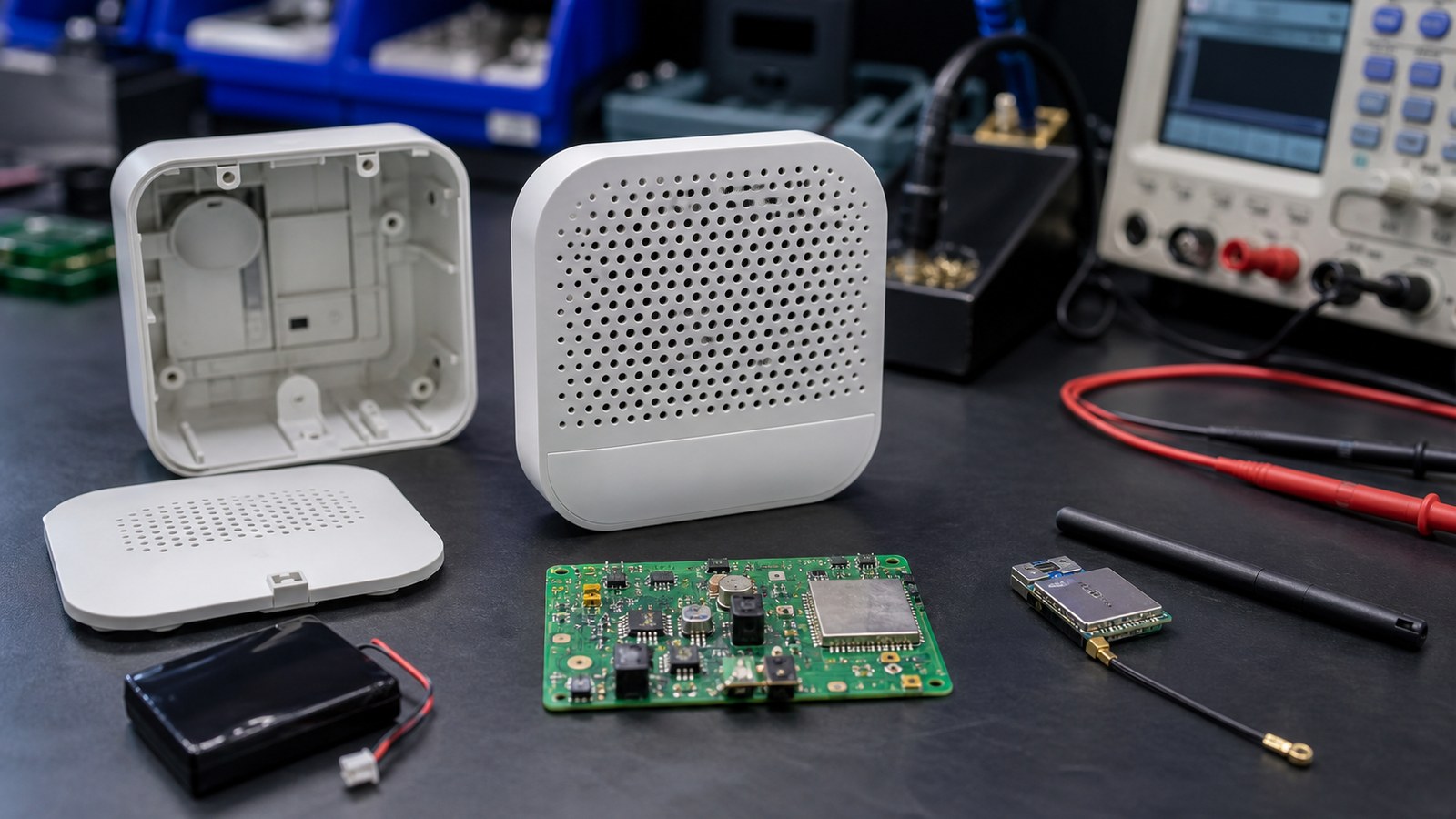
If you are choosing a payment soundbox manufacturer, you need more than a parts list. A robust payment soundbox integrates audio hardware, reliable connectivity (4G/Wi‑Fi or hybrid), battery and power management, a tamper‑ready enclosure, firmware for secure OTA updates, and a certification plan that covers radio, EMC and battery safety. This guide walks hardware founders, product managers and OEM/ODM buyers through practical, production-oriented decisions.
Core architecture patterns for a payment soundbox
At a high level you’ll pick between two architecture patterns:
- Thin client — minimal local logic, cloud-driven playback commands (low local storage, small MCU, simpler firmware).
- Smart edge device — local queuing, richer logic, on-device analytics or local payment verification (requires more CPU, storage, secure element options).
Choice depends on latency, offline must‑work needs, and whether the device will handle sensitive data (in which case you must plan secure storage and appropriate certification/attestation).
Key hardware blocks — speakers, amplifiers, and acoustic design
Speaker selection and acoustic design are central to the product experience. Consider:
- Speaker type: full‑range vs small woofer + tweeter. For clear payment tones and voice prompts, a compact full‑range 1.5–3″ speaker or smart buzzer can work.
- Amp selection: Class‑D amps give high efficiency for battery devices. Match amp power to speaker impedance and enclosure volume.
- Acoustic path: vents, grills and internal baffling impact SPL and clarity. Keep the speaker away from RF antennas to reduce microphonic coupling.
- Quality checks: SPL measurement across units and harmonic distortion specs should be part of incoming inspection and production testing.
Power and battery planning
Battery choices drive size, runtime and certification needs:
- Chemistry: Lithium‑ion or LiPo are common for compact soundboxes. Consider replaceable packs for field service vs sealed internal packs for ingress protection.
- Capacity tradeoffs: estimate active duty‑cycles (playback length, network radios) to size mAh. Add headroom for battery degradation over life.
- Power management: use PMICs for charging, fuel gauge ICs for accurate reporting, and thermal protection circuits.
- Safety and testing: plan UN38.3 and IEC 62133 tests for batteries; consult your certification lab early to scope tests correctly.
Connectivity: 4G vs Wi‑Fi vs hybrid — a quick decision framework
Select connectivity based on deployment scale, installation friction, and cost structure. Include fallback strategies for reliability.
| Option | Pros | Cons | When to pick |
|---|---|---|---|
| 4G (cellular) | Broad coverage, simple install, consistent connectivity | SIM/subscription costs, radio certification per region | Retail counters, mobile or widely distributed installs |
| Wi‑Fi | Lower ongoing cost, high throughput | Network dependency, guest Wi‑Fi pitfalls, provisioning overhead | Controlled venues with IT-managed Wi‑Fi |
| Hybrid (Wi‑Fi + 4G fallback) | Reliable connectivity, resiliency for outages | Higher BOM and power considerations | Critical payments where uptime matters |
Enclosure and mechanical considerations
Design the enclosure around acoustic performance, thermal management and tamper resistance:
- Material choice: ABS, PC, or aluminum for EM shielding. Choose flame‑retardant grades if required.
- Mounting and visibility: wall vs counter mount influences shape and speaker orientation.
- Ingress protection: IP54 or above if installed in semi‑outdoor locations.
- Serviceability: plan battery replacement, SIM access, and firmware recovery pads for factory servicing.
Firmware, security and OTA update strategy
Firmware determines device reliability and field maintenance costs:
- Bootloader and A/B firmware partitions to allow safe OTA rollback.
- Signed firmware and secure boot to protect device integrity.
- Network efficiency: compression and caching for audio files if you host sounds locally.
- Diagnostics and remote logging that respect privacy and bandwidth limits.
Production testing and QC you should include
Move beyond functional checks—build a test plan that scales:
- Incoming inspection for speakers, batteries, RF modules, antennas.
- Functional jig tests: audio playback verification, cellular attach, Wi‑Fi connect, LED and button tests.
- Audio QA: SPL measurement and frequency check per unit or sampling plan.
- Burn‑in and soak tests to catch early failures before shipping.
- Labeling and serialization for traceability and compliance.
Certification planning — radio, EMC and battery safety
Start certification planning early. Typical scope includes:
- Radio approvals (FCC, CE/RED, or regional equivalents) for 4G/Wi‑Fi modules. If using pre‑certified modules, confirm integration testing needs.
- EMC and safety testing for the finished product.
- Battery tests (UN38.3, IEC 62133) and shipping constraints for lithium cells.
- Payment-related compliance: if your device stores or processes cardholder data (PINs, keys), consult payment security standards and your acquiring partner early.
Certification timelines and requirements change—verify current standards with accredited labs and carriers before committing to procurement.
Supplier & manufacturing checklist for selecting a payment soundbox manufacturer
- Experience with radio devices and battery handling in production.
- Test jig capabilities and in‑house RF/EMC pre‑testing.
- Quality management (ISO) and traceability for components like speakers and batteries.
- OTA server and lifecycle support model for firmware updates.
FAQ
What should I ask a payment soundbox manufacturer about speaker selection?
Ask for SPL measurements, recommended amplifier matching, enclosure recommendations, acoustic test reports and failure rates from incoming inspection. Request production samples to verify sound quality in your target mounting scenario.
How do I estimate battery life for a payment soundbox?
Estimate average daily active time (playback seconds per day), radio on‑time, and idle consumption. Add a margin for aging and network retransmits. Prototype with realistic usage patterns and verify with battery cycling tests. Always verify shipping and safety requirements for battery chemistry you choose.
Can a payment soundbox manufacturer handle certification?
Many experienced hardware manufacturers, including Shenzhen‑based partners like Futurezen, can manage certification coordination, pre‑compliance testing and documentation. Confirm their lab relationships and past device types, and plan to verify all regulatory requirements with accredited labs and carriers.
Which connectivity option is best for reliability?
Hybrid Wi‑Fi + 4G with automatic failover offers the strongest reliability profile for distributed payment soundboxes, but it increases BOM and power consumption. Use the decision table above to weigh tradeoffs for your use case.
How do I arrange production testing for audio quality?
Include SPL and harmonic distortion checks in your production test plan, use a calibrated microphone and set pass/fail tolerances. A sampling plan may balance speed and quality for large volumes.
Next steps — work with a Shenzhen manufacturing partner
If you’re selecting a payment soundbox manufacturer or building a prototype, discuss your product architecture, BOM tradeoffs, certification path and a scalable production test plan. Futurezen is a Shenzhen‑based product development and manufacturing partner and can help scope RF integration, battery compliance and factory test strategies. Contact Futurezen to map out a realistic timeline, prototype BOM and certification roadmap.