
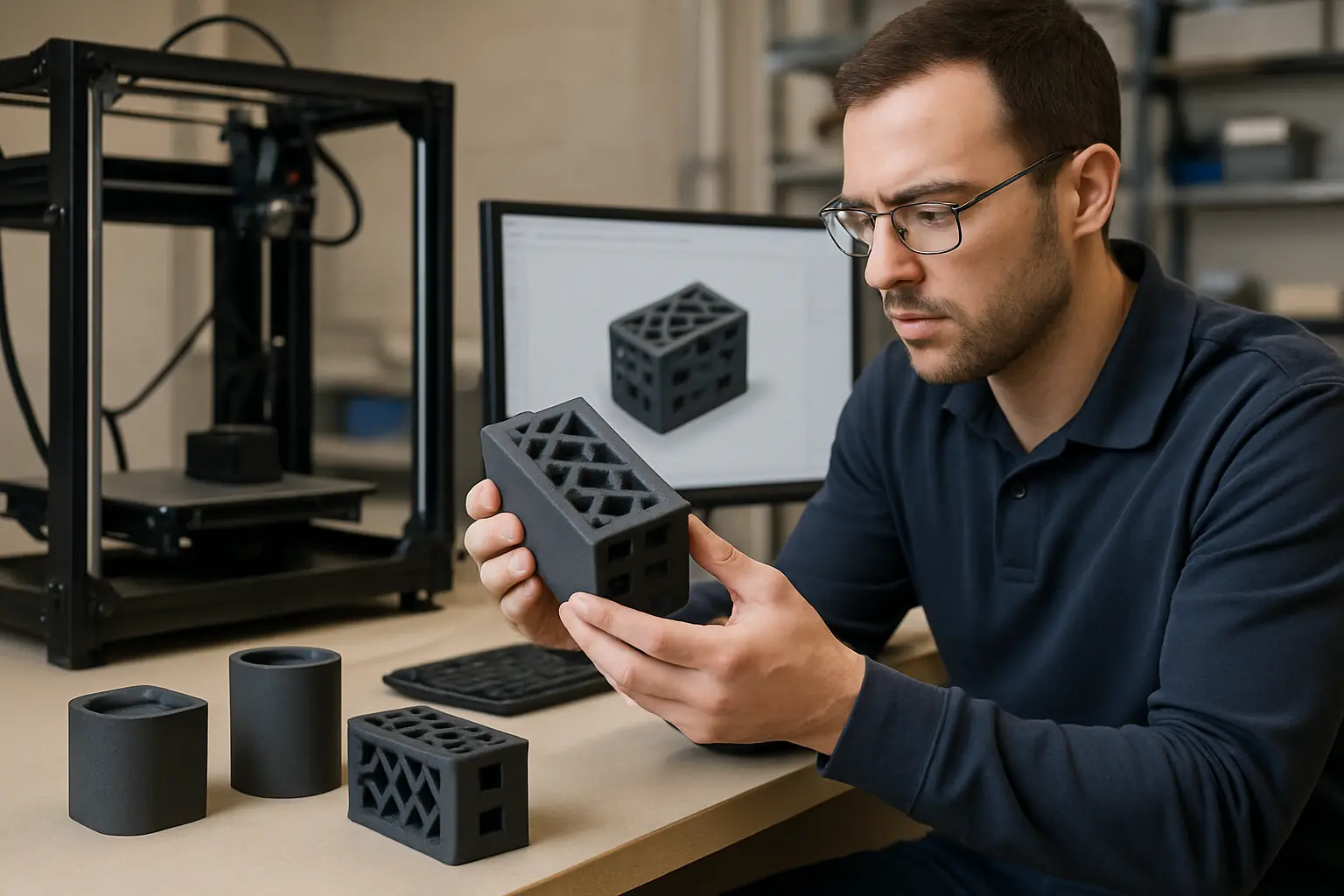
Graphite Additive Manufacturing: Processes, Materials and When It Fits a Product
Decision first: choose graphite additive manufacturing when your product needs custom-shaped conductive or thermally conductive carbon parts that would be difficult or slow to produce with subtractive machining or conventional molding. Use additive graphite for complex internal channels, integrated electrodes, heat spreaders, and small series where design iteration matters.
Byline: Futurezen editorial team
What “graphite additive manufacturing” means in practice
Graphite additive manufacturing is any layerwise or jet-based process that builds parts whose primary functional material is graphite or high-carbon material derived to behave like graphite after processing. Typical workflows start with a printable composition (graphite powder mixed with binders, dispersions of graphite flakes or graphene-rich inks), deposit that material into the intended geometry, and then apply post-processing steps such as debinding, thermal treatment (carbonization or graphitization), and secondary finishing.
Common processes used
- Direct ink writing (DIW) / extrusion of graphite inks: viscous pastes or gels containing graphite flakes are extruded through a nozzle and dried; useful for freeform electrodes and channels.
- Binder jetting with graphite powder: powder layers are selectively bound and then thermally processed to improve cohesion and conductivity; suitable for more complex 3D geometries that need post-sintering strength.
- Inkjet / aerosol jet deposition: thin conductive graphite or graphene inks printed on substrates for patterned conductive traces or sensors; used when fine resolution is required on planar parts.
- Hybrid prints with curing and graphitization: multi-step flows where printed organics are converted to carbon through controlled high-temperature cycles to reach graphite-like structure and properties.
Materials and what they deliver
Materials for graphite additive manufacturing range from graphite powders and expanded graphite flakes to graphene-enriched inks. Key functional outcomes are:
- Electrical conductivity: graphite-based parts conduct electricity and can replace metal traces or electrodes in some designs.
- Thermal conductivity: graphite provides effective heat spreading and can be formed into conformal heat sinks or thermal interface structures.
- Chemical stability: graphitized carbon is chemically stable in many environments where metals corrode.
- Lightweight structure: carbon-based parts can achieve a favorable stiffness-to-weight ratio for some applications.
Note: Printed graphite parts often show anisotropic properties (direction-dependent conductivity and strength) because of flake orientation during deposition.
Design and engineering considerations
Designing for graphite additive manufacturing requires accounting for the material and process behaviours rather than copying metal or plastic part designs.
- Shrinkage and densification: binder removal and thermal conversion cause part shrinkage and porosity changes; designs must include compensation for final dimensions.
- Feature resolution and surface finish: minimum feature size depends on the printing method and ink rheology; surface finish usually requires secondary finishing if smooth surfaces are essential.
- Mechanical limits: printed graphite parts have different fracture and flexural behaviour than metals; avoid stress concentrations and sharp internal corners where possible.
- Integration with other materials: combining printed graphite with metals or plastics requires attention to adhesion and thermal expansion mismatches.
When graphite additive manufacturing fits a product
Choose this approach when several of the following apply:
- Your product benefits from integrated, three-dimensional conductive paths or electrodes that are difficult to form by laminates or wiring.
- Custom thermal management features with conformal shapes are needed for tight spaces or irregular housings.
- You need fast design iteration on conductive or thermal components in low- to mid-volume production runs.
- Weight reduction and chemical corrosion resistance matter more than high tensile strength or metal-level stiffness.
- The part geometry makes tooling (injection molds, dies) expensive or impractical for the expected volumes.
When it usually isn’t the right choice
- If the product requires metal-level mechanical strength, fatigue resistance or tight metal tolerances, metallic manufacturing methods are generally preferable.
- For very high-volume, low-cost commodity parts, traditional molding or stamping often gives lower unit costs once tooling is amortized.
- If the application needs mirror-like surface finishes or ultrafine dimensional accuracy without secondary processing, alternative manufacturing paths may be more suitable.
Typical production steps
- Design and printability assessment: check geometry, anticipated shrinkage and layer orientation.
- Material selection: choose appropriate graphite powder or ink formulation for conductivity, stiffness and processing temperature.
- Printing or deposition: form the green part using extrusion, jetting or binder-based layering.
- Debinding and thermal treatment: remove binders and convert organics to carbon; optional graphitization to increase crystalline order and conductivity.
- Post-processing: machining, infiltration, coating or surface finishing to meet tolerances, sealing or environmental requirements.
Questions product teams should ask their manufacturing partner
- What final material properties (electrical, thermal, mechanical) can you guarantee after post-processing?
- How do you quantify and compensate for shrinkage and dimensional variation?
- What resolution, minimum feature size and surface finish can you deliver for the selected process?
- Which secondary processes (coating, machining, infiltration) do you offer to reach production-ready parts?
- What environmental or chemical compatibility testing do you support for graphite components?
Use cases and illustrative scenarios
Typical uses include conformal heat spreaders in compact electronics, printed electrodes for sensors or electrochemical devices, EMI mitigation components where a conductive carbon form is acceptable, and specialized tooling or jigs that need conductive surfaces. These scenarios are illustrative; evaluate suitability against your product’s functional and regulatory requirements.
FAQs
- Does printed graphite match metal conductors?
- Graphite can provide good electrical conductivity but usually not at the same level as copper or silver. Choice depends on acceptable resistance and environmental needs.
- Can printed graphite parts withstand high temperatures?
- Graphitized parts tolerate high temperatures better than many polymers; the actual limit depends on material formulation and any binder residues.
- Are printed graphite parts waterproof or chemically inert?
- Graphite is chemically stable, but porosity and surface condition matter. Sealing or infiltration is often required for liquid- or gas-tight applications.
- How repeatable are dimensions and properties in production?
- Repeatability improves with process control and careful post-processing. Early prototyping is important to establish tolerances and yield before scaling volume production.