
Which depth of connectivity testing should I choose before launch?
Which depth of connectivity testing should I choose before launch, and how does that affect my launch schedule and customer experience? If you need basic out of box connectivity then choose a lean plan; if your customers must never call support for pairing or registration then choose a fuller plan. In this article we use the phrase connectivity testing manufacturing to mean the factory checks and records that prove a wireless product will connect when a customer first uses it, and we show the tradeoffs so you can pick the right option for your launch.
Which connectivity testing manufacturing option gets my product to market sooner?
Choose a lean connectivity testing manufacturing option when your first release is a pilot or MVP that can accept some field tuning and rapid updates. A lean plan focuses on the user journeys customers meet right away, for example Bluetooth pairing and initial cloud sign in, which keeps per unit test time low so more units move through the line. This gets more units shipped sooner while giving your team clear data on early field issues.
What do I gain or trade off by choosing a lean versus full test plan?
Choosing lean trades detailed radio and range validation for speed and throughput. You gain faster production and simpler fixtures, and you accept that detailed antenna or long range checks will be deferred to later builds. Choosing full validation trades more time on each unit for higher confidence that radios, antennas, and cellular provisioning will behave consistently in the field. The concrete outcome is simpler launch logistics with lean testing, or fewer field adjustments and support tickets with full testing.
How should a manufacturing partner run connectivity tests for my launch?
A good manufacturing partner maps the connections your product uses onto user journeys, then chooses the test depth that matches your launch tolerance. They sequence tests to catch the biggest problems first, for example pairing and registration before extended range trials, and they record results so you can trace issues. The concrete result is a documented test flow that aligns with your launch readiness target.
What will my manufacturing partner handle for connectivity testing?
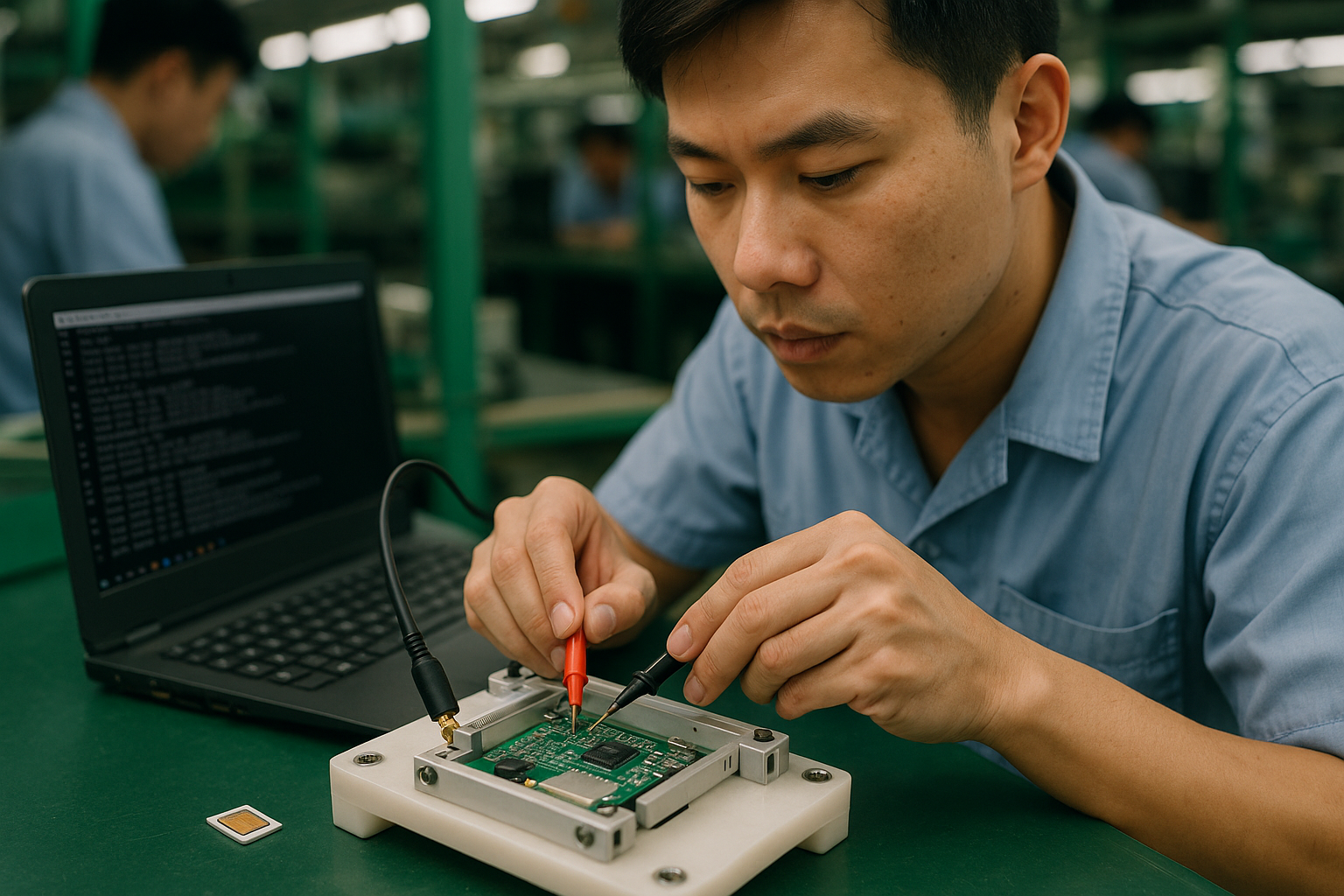
Your manufacturing partner will design and build the production test fixture, write the automation scripts that run on the line, and set up the lab and staging endpoints the tests use. They will also capture any SIM and IMEI data into production records and run cloud handshake trials against your staging services. Concretely, this means your team decides the scope and the partner delivers repeatable execution, so you do not need to write bench test code.
One-line definitions you can quote
IMEI, the unique mobile device identifier used by cellular networks, used to register a modem. SIM identifier, the SIM card identifier your carrier uses, recorded to link a SIM to a device. RSSI, a simple signal-strength reading, used to compare relative reception. LoRa, a long-range low-power wireless option used for wide area IoT links. Test fixture, a production jig that holds the unit and provides repeatable connections for testing. Each definition helps you understand what will be recorded during production testing.
| Scope | When to choose | What we check | Time to include |
|---|---|---|---|
| Lean acceptance | First customer pilots and MVPs | Bluetooth pairing, Wi Fi RSSI spot checks, cloud login | Minimal test fixture, fastest throughput |
| Full production validation | Wider launch or regulated markets | Antenna validation, LoRa range, 4G registration, SIM and IMEI records, extended cloud handshake trials | Detailed fixtures, sample-based range tests |
Which tests must work on first use for my customers?
Focus first on the steps your customers take immediately after unboxing. Typical must-work items are Bluetooth pairing, Wi Fi connection, and any cellular registration that allows a device to phone home. If your product relies on long range links, include LoRa range checks in initial validation. A concrete recommendation is to make the primary pairing and cloud handshake tests mandatory on every unit so shipped devices have verified user journeys.
How do these choices show up in production data and support?
Lean plans produce a compact set of logs that highlight immediate failures, which helps your support team identify early software or provisioning problems. Full plans produce richer records, for example per unit RSSI samples, IMEI and SIM identifier entries, and repeat cloud handshake traces, which reduce ambiguity when a customer reports an intermittent issue. Concretely, the fuller the plan the more context you get for each support case.
How long will these tests add to my line, and what changes across runs?
Test time per unit rises with the depth of checks. Lean plans add small, predictable steps that scale with throughput. Full plans add longer measurements and sample range trials that run on representative units rather than every single unit. The practical outcome is that you can preserve line speed by mixing unit level lean checks with periodic deeper validation on samples.
FAQ
Do I need antenna validation for a simple Bluetooth product?
If the product must pair reliably in many orientations or through varying enclosures, choose at least a basic antenna check during production validation. Concretely, this reduces unexpected returns and pairing tickets after launch.
How do you capture SIM and IMEI records during production?
The manufacturing test sequence reads the IMEI and SIM identifier from the module and writes those values into the production database. Concretely, this ensures shipped units are provisioned and traceable without requiring your team to add test software.
Can you validate cloud handshakes against our staging environment?
Yes. A partner can run authenticated exchanges against your staging cloud to confirm provisioning, token refresh, and lightweight message exchange before mass production. Concretely, this verifies the end to end flow your customers will use on first use.
Where can I learn more about radio and pairing guidance?
For Bluetooth design and conformance guidance see the Bluetooth SIG site at bluetooth.com. Concretely, cross checking against vendor guidance helps interpret production measurements.
If you want to discuss which connectivity testing manufacturing depth fits your product, prototypes, or production plan, contact Shenzhen Futurezen Co. Ltd. Use our contact form at /contact/ to start the conversation. We will review your user journeys, recommend a lean or full plan, and show how we will handle fixtures, automation, and lab setup so you can focus on product decisions.