
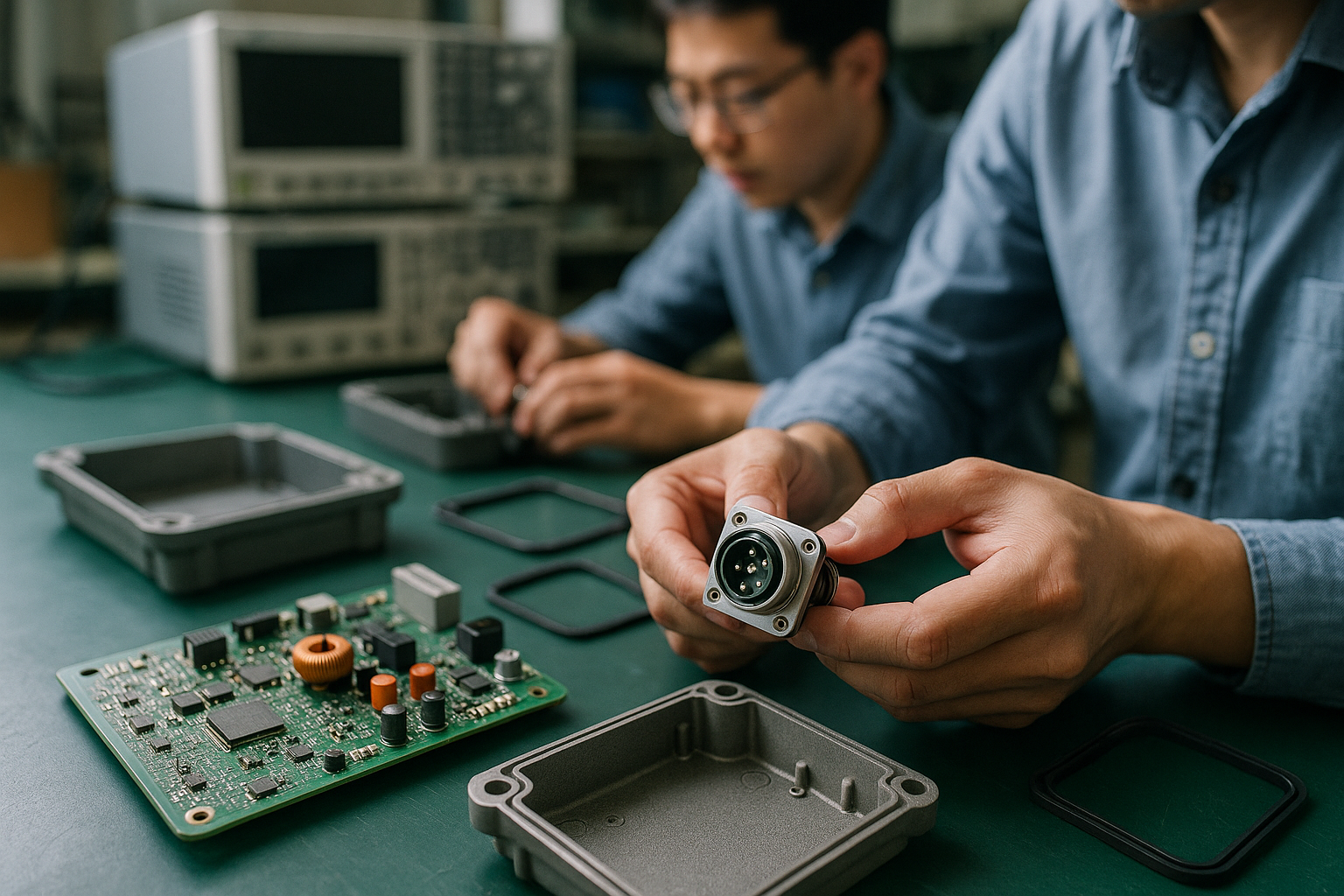
The core decision in industrial IoT device manufacturing is the degree of ruggedness you need, paired with the service model you will support. That decision shapes enclosure choice, how we plan testing and engineering sequencing, and when to lock parts and production steps so your product ships reliably.
industrial IoT device manufacturing: Which enclosure and power approach fits my product and deployment?
Start by deciding whether your product will be deployed in protected indoor spaces or in exposed, harsh environments. An off the shelf sealed box usually gets you to market faster, because it reduces custom engineering. A custom rugged enclosure pays off for long term outdoor deployments, unusual mounting, or specific connector layouts.
Simple definitions to help the conversation: tooling means the molds, dies, and fixtures used to produce parts at scale. Board means the circuit board, the electronic assembly that holds chips, connectors, and sensors. Choosing an off the shelf enclosure reduces tooling work and speeds prototypes. Choosing a custom housing requires more upfront design and samples, but reduces field fixes later when the product must meet tight environmental or mechanical constraints.
How do I pick enclosure and component grades for my worst temperature and vibration conditions?
Decide on the worst case environment, not the average. If devices sit in hot cabinets or attach to moving equipment, choose higher temperature rated components and vibration tolerant mounting early. That decision changes which components we propose and the testing sequence.
We translate your environmental choices into practical steps. For example, if you set a maximum ambient temperature and expected vibration level before the first prototypes, our team selects appropriate component packages and placement on the circuit board so you avoid rework after field issues appear. The expected service interval, also called mean time between failures (MTBF), is the average operating time between failures and helps set expectations for spare parts and maintenance intervals.
Which connector accessibility, power source, and surge protection choices match my support plan?
Decide whether connectors need to be user accessible or permanently sealed. Accessible connectors make early field trials and module swaps simpler. Sealed connections reduce service touch points and improve durability in wet or dusty settings. For power, decide if the device will use external power supplies, vehicle power, or batteries. That drives surge protection and electrostatic protection choices.
We incorporate industry testing requirements into the plan. Standards bodies publish tests for electromagnetic compatibility and surge immunity, and we reference those standards during validation, for example at https://www.iec.ch/.
How should I treat wireless connectivity and antenna testing in my schedule?
Decide whether connectivity uptime is core to the customer experience. If it is, plan to validate antenna placement in the final enclosure and to include chassis grounding strategies early. If RF, or radio frequency, is a secondary function, a module with a prequalified antenna can speed development.
We manage the RF test iterations as part of the prototype cycle, so you do not need to run technical experiments. When antenna tuning is needed, we schedule a focused test pass with the final enclosure to catch interactions between casing materials and radio performance before production decisions are locked.
| Choice | Time to Market | Operational Risk | When to pick |
|---|---|---|---|
| Off-the-shelf enclosure, standard power | Faster | Moderate | Early prototypes, controlled environments |
| Custom rugged enclosure, sealed connectors | Longer | Lower in harsh environments | Products in outdoor, wet, or dusty sites |
| User-accessible connectors, modular power | Moderate | Higher serviceability | When field swaps are expected |
| Sealed power input, integrated surge protection | Moderate | Lower field failures | When uptime and low maintenance matter |
How do we sequence engineering so you can focus on product choices?
We run a short staged cycle so product decisions are translated into engineering tasks without you managing technical details. First we define deployment and service expectations. Then we prototype with a pragmatic parts list and an off the shelf or early custom enclosure sample. We test in the target enclosure, validate antenna placement and surge protection if required, and iterate only where tests show a mismatch.
This approach catches design issues before production tooling, which is where changes become disruptive. We also keep a documented list of field-proven component substitutes and test evidence. You receive decision summaries and trade off reasoning, not raw engineering detail, so stakeholders can follow progress while our team handles the technical sequencing.
When should I lock long-life parts and serviceability choices?
Decide early what long-life means for your product, whether that is a guaranteed supply window or the ability to substitute approved parts during service. Lock long-life and critical serviceability choices before final enclosure tooling. Documenting approved substitutes and the validation evidence keeps your product supportable over years without continuous sourcing work from your team.
Decision checklist, and when to lock each choice
- Enclosure grade: pick during initial requirements and before detailed enclosure drawings, so tooling or enclosure selection is aligned to environment.
- Connector accessibility: decide in concept design, lock before enclosure finalization to avoid late mechanical changes.
- Power source and surge strategy: choose during architecture and validate during prototype testing.
- RF criticality and antenna placement: decide at product definition, validate in the final enclosure during prototype testing.
- Serviceability and expected service interval, also called mean time between failures (MTBF): define in requirements and plan diagnostics and spare strategy before production.
- Long-life components and approved substitutes: identify during first prototypes and document before final tooling.
FAQ
Do I need a fully sealed enclosure for every industrial IoT product?
No. Choose a sealed enclosure when deployments will see water, dust, or contaminants. For indoor, protected installations, an off the shelf enclosure with internal sealing and filtered vents often suffices, and it shortens development time.
How do you avoid late RF problems if the casing changes?
We validate antenna placement in the final enclosure during prototype testing. If casing changes are likely, we schedule a planned RF test iteration so tuning is part of the timeline, not an unexpected delay.
When is the parts list locked for long-life support?
Lock key long-life components once product specifications and target environments are approved, and before final enclosure tooling. We then bench test candidates under expected conditions and document approved substitutes.
If you want to discuss the right choices for your product, prototypes, or manufacturing plan, Shenzhen Futurezen Co. Ltd. helps translate your product decisions into an engineering sequence that keeps your team focused on features. Contact us via our services page at /services/ or schedule a short technical review at /contact/ to review trade offs and a recommended test plan.
External reference: for standards on electromagnetic and surge testing, see the International Electrotechnical Commission at https://www.iec.ch/.