
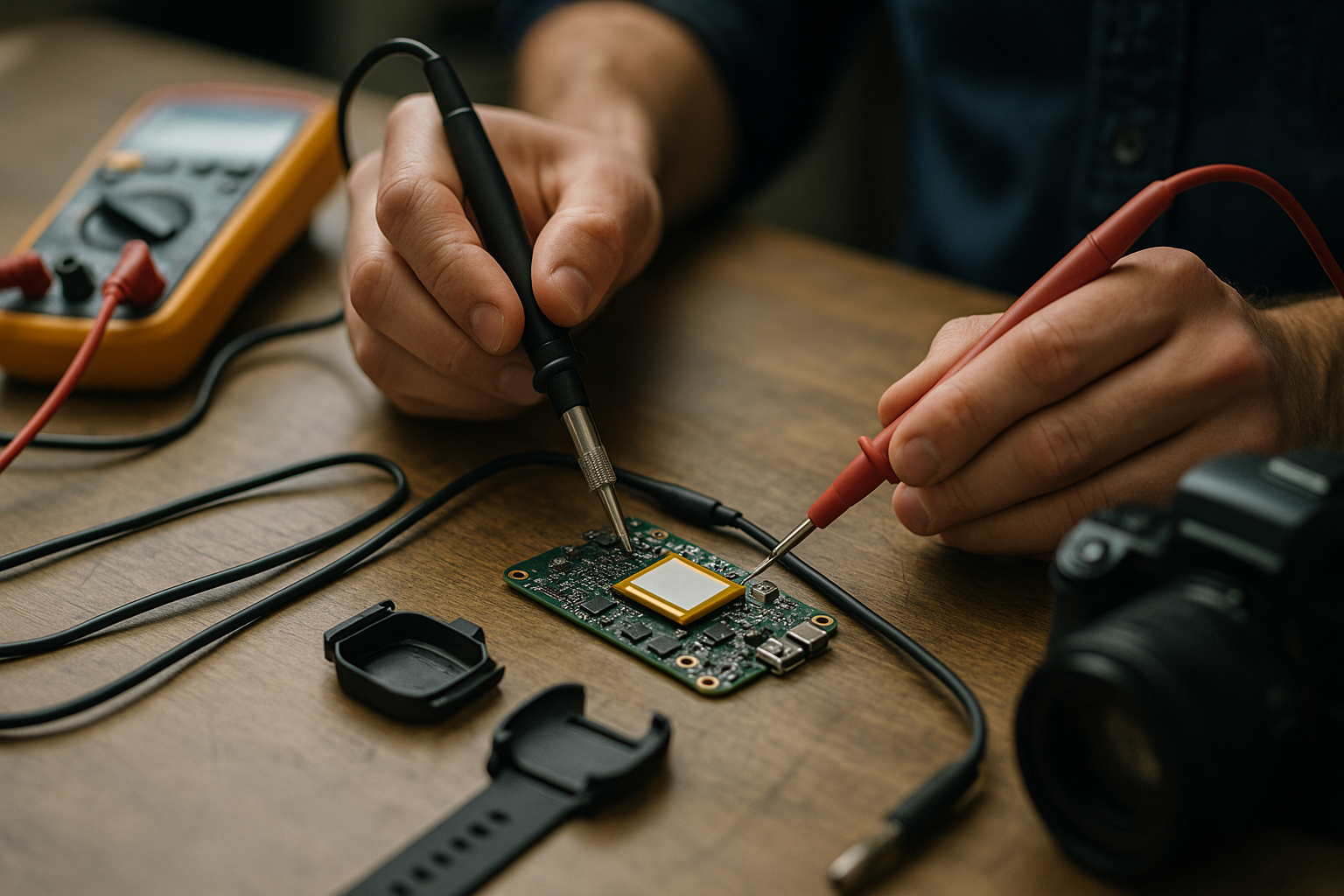
Battery life in wearables starts at architecture
Battery life in wearables is one of the top constraints hardware founders and product managers face when building connected AI devices. Early decisions about battery capacity, power states, radio design, sensors, display and speaker load, and charging strategy determine whether your product meets user expectations without excessive size or cost. This article summarizes practical tradeoffs and test methods for product teams.
Why battery life matters for AI wearables
AI workloads add compute and sensor requirements that change typical wearable duty cycles. Even light local inference, continuous sensor fusion, or always on wake words can shift a product from multi day operation to same day charging if not planned. For sourcing and BOM decisions you need realistic battery budgets before locking components or enclosures.
Battery life in wearables: active versus sleep current
Separate your power budget into active and sleep modes. Active current is the consumption when the radio, sensors, CPU, and display or speaker are awake. Sleep current is what remains when the device is idle but must remain responsive to interrupts or low power wake words. Typical planning steps:
- Measure component currents at the expected operating voltages. Use real silicon measurements, not datasheet peak values alone.
- Create a time budget for each mode per typical use case. For example 2 minutes active per hour with the screen off most of the time will have a very different battery draw than continuous heart rate sampling.
- Target sub microampere sleep current where possible and treat anything above a few microamperes as a major contributor to battery drain for small cells.
Radio duty cycle, sensors, and compute
The radio duty cycle is often the single largest variable for connected wearables. Design choices and tradeoffs:
- Bluetooth Low Energy: tune connection intervals, slave latency, and payload aggregation to reduce wake ups.
- Cellular or NB IoT: batch data and use PSM or eDRX where carriers and modules support those features.
- Sensor sampling: sample at the lowest acceptable rate and use local edge filtering to avoid unnecessary transmissions.
- AI inference: schedule heavy inference when the user is active or when charging. Use model quantization and hardware accelerators to reduce energy per inference.
Display and audio load
Displays and speakers can dominate active current. OLEDs draw by pixel and brightness, LCD backlights draw constant current. Audio amplifiers and speakers can spike current during playback. Strategies:
- Prefer simple visual feedback for background operations, and only turn on high power display subsystems for explicit user interactions.
- Use voice at low duty cycles and mute pathways when not needed. Consider low power haptic cues instead of audio for some notifications.
Charging case options and system design tradeoffs
A charging case can extend usable time, but it changes BOM, mechanical design, and perceived reliability. Common approaches include integrated larger cells, external charging cases, and replaceable batteries. Tradeoffs to discuss with sourcing and manufacturing teams:
- Integrated larger battery: simpler UX but increases device size and regulatory scope.
- Charging case: reduces product size, adds a new assembly and enclosure BOM, and requires contact or wireless charging hardware.
- Replaceable cells: serviceable, but rarely acceptable for waterproof wearables and complicates regulatory testing.
Firmware optimization and power states
Firmware controls power states and radio behavior. Key tactics:
- Implement hierarchical power states, with minimal clocks running in deep sleep.
- Throttle background tasks, defer uploads, and coalesce sensor reads and radio transmissions.
- Use hardware wake sources like FIFO thresholds or intelligent sensor wake features to avoid MCU wake ups.
- Monitor battery voltage and adapt sensor and radio behavior as the battery drains to preserve key functionality.
Thermal limits and their impact on battery life
Heat raises internal resistance and can reduce effective capacity and accelerate degradation. Plan thermal margins for continuous AI workloads, and validate battery performance across your expected operating temperature range. For devices intended to run sustained inference, consider thermal throttling or offloading to paired devices or the cloud.
Realistic test conditions and metrics
Lab bench estimates using idealized duty cycles are not enough. Test under realistic conditions before finalizing architecture:
- Run long duration tests with representative user patterns including background syncs, notifications, sensor bursts, and charging cycles.
- Include temperature chamber runs to capture worst case and cold start behavior.
- Measure cycle life, charge time, and time to critical battery thresholds rather than single runtime numbers.
- Document test rigs, record representative traces, and share metrics with stakeholders to make tradeoffs transparent.
| Approach | Typical use case | Pros | Cons |
|---|---|---|---|
| Small internal cell | Ultra compact wearables, infrequent connectivity | Small size, lower BOM cost | Short runtime, frequent charging |
| Larger internal cell | All day health tracking, local AI inference | Longer runtime, fewer user charges | Increased size, regulatory scope |
| Charging case | Earbuds, premium wearables needing extended use | Smaller device, extended field time | Adds assembly, enclosure complexity, cost |
| Removable battery | Rugged or serviceable devices | Field swap, quick replacement | Waterproofing and user experience challenges |
FAQ
How can I extend battery life in wearables without increasing size?
Reduce radio duty cycle, lower sensor sampling rates, use local event detection to avoid continuous transmission, and optimize firmware to spend more time in deep sleep. Review display and audio usage carefully and consider hardware accelerators for AI tasks.
What is radio duty cycle and why is it important?
Radio duty cycle is the fraction of time the radio is active. It affects energy use directly because each radio wake has a fixed handshake and transmission cost. Aggregating payloads and increasing connection intervals reduce duty cycle.
How do I set realistic test conditions for battery life?
Use representative user behavior traces, run tests across expected temperature ranges, simulate network conditions and notification patterns, and measure both runtime and battery health over many charge cycles.
Should I choose a charging case or a bigger battery?
It depends on priorities. A charging case keeps the wearable small and can extend usable time, but it increases BOM and manufacturing complexity. A larger internal battery simplifies UX but increases size and regulatory testing. Use the decision framework table above to align options with your target user and BOM constraints.
Next steps and practical CTA
If you are making architecture, BOM, or certification decisions, our Shenzhen based product development and manufacturing team can help. Contact Shenzhen Futurezen Co. Ltd. or visit our services page to schedule a review with our team to go over battery budgets, component selection, firmware power states, and a realistic test plan before you lock the enclosure or order tooling.
Practical verification is essential. Do not rely on datasheet peak currents alone. Measure live silicon in the full system and validate across temperature and usage scenarios before making procurement or certification commitments.