
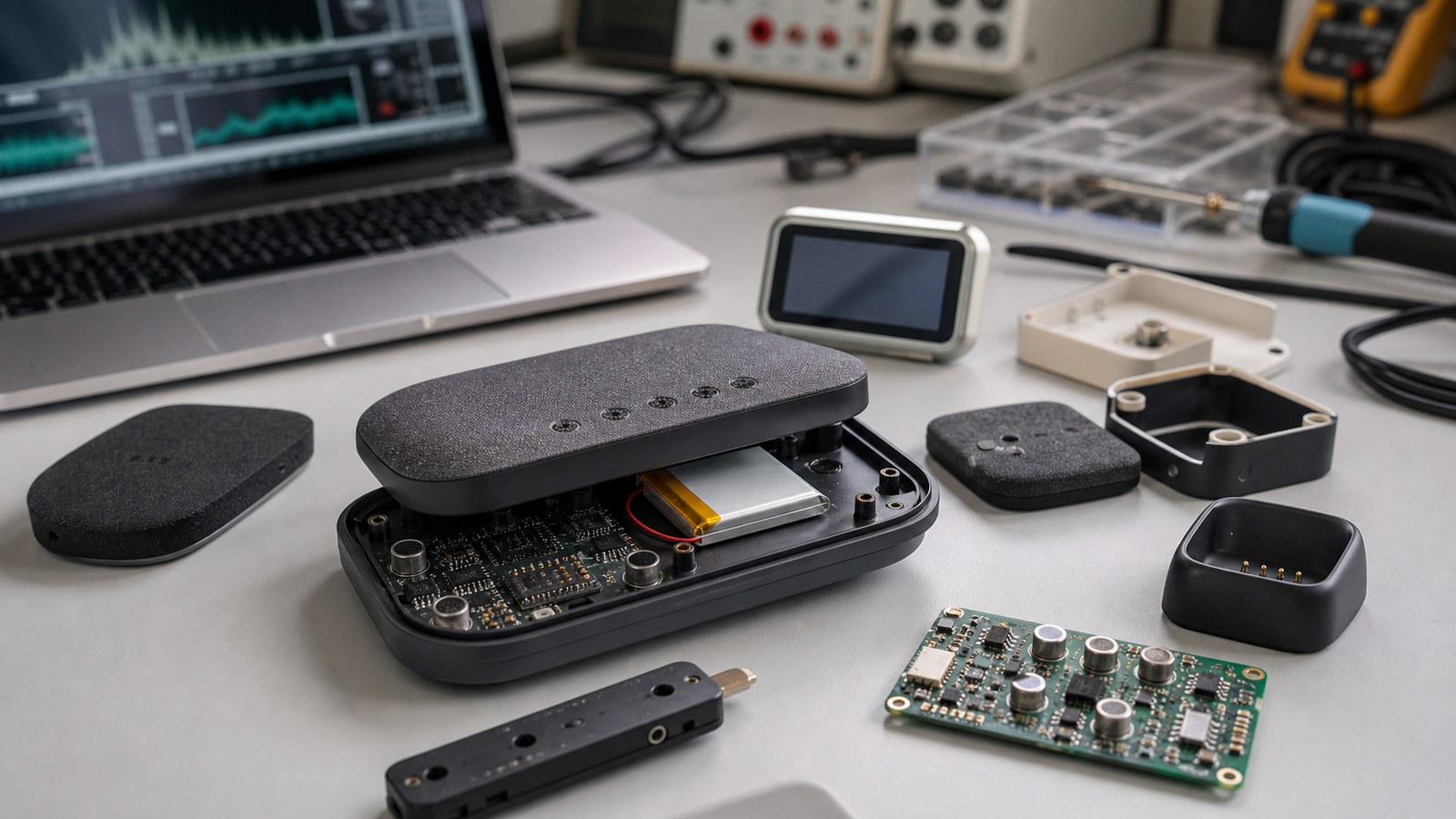
Building an AI note taker requires decisions across hardware, casing, charging, connectivity, and user experience. This guide to AI note taker product development helps hardware founders, product managers, and OEM buyers choose an architecture that balances prototyping speed, unit cost, reliability, and manufacturability.
Key hardware choices for AI note taker product development
Start with a clear use case. Is your device transcribing meetings, summarizing voice notes, or operating as a capture device for later cloud analysis? That use case drives processor selection, microphone count, memory, battery size, and RF modules. Typical hardware choices include:
- Processor: MCU for control plus an application processor or NPU for on device inference, or a lower power MCU if cloud processing handles inference.
- MEMS microphones: Multiple MEMS mics for beamforming and far field pickup. Choose matched mic modules, consider SNR and sensitivity, and place them for acoustic separation.
- Audio preprocessing: Low noise analog front end, ADC quality, and digital filtering. On device noise suppression benefits from good analog capture.
- Power: Battery chemistry and capacity sized to meet target runtime with peak CPU loads during inference or active streaming.
- Connectivity modules: Bluetooth LE for local transfer, optional Wi Fi, and an LTE or 4G module if cellular connectivity is required.
For production you must also plan for parts lifecycle and multi sourcing to reduce risk. Work with suppliers who publish lifecycle status and sample lead times.
Casing decisions: CNC prototyping versus plastic tooling for volume
Choose CNC or 3D printed prototypes for early validation, mechanical fit, and ergonomics. For volume, injection molded plastic with dedicated tooling is typical. Compare the options:
- CNC and 3D printed prototypes: Fast iteration, low upfront cost, higher per unit cost, good for testing acoustics and user fit.
- Injection molded tooling: High upfront cost and long lead time, low per unit cost, tight tolerances for acoustic ports and button interfaces.
Key tradeoffs: acoustic performance and assembly consistency. Injection molding can integrate acoustic chambers, snap fits, and inner bosses for PCB mounting. However tooling changes are expensive and slow, so freeze interfaces before committing. Consider mid run options like low volume urethane cast parts when you need up to a few hundred units without full tooling.
Microphones and noise cancellation
MEMS microphones are standard for form factor and reliability. For an AI note taker, use at least two to four mics for beamforming and spatial filtering. Combine these with digital noise reduction algorithms running on a DSP or NPU. Pay attention to:
- Microphone placement relative to casing openings to avoid muffled audio.
- Acoustic ports and gaskets to maintain waterproofing ratings without blocking sound.
- Calibration and matching of mic gains in firmware to enable effective beamforming.
Noise cancellation quality depends on both analog front end and DSP. Prototype early and measure with realistic room acoustics.
Charging: wireless versus magnetic wire charging
Wireless charging provides a frictionless user experience, while magnetic wired charging or pogo pins offer faster charging and easier validation of a physical connection. Consider:
- Wireless Qi coils: Good UX, requires internal coil space, introduces thermal considerations and may affect battery size and placement.
- Magnetic connectors or pogo pins: Robust, cheaper, easier to seal with a closed cover, predictable charging current, and simpler to test on the production line.
Tradeoff: wireless charging increases cost and may reduce available internal volume. Magnetic connectors can simplify waterproofing and test fixturing. Choose based on target price point and expected usage patterns.
Connectivity: Bluetooth versus 4G
Bluetooth is ideal for low latency pairing with a companion app and local transfer of audio or transcripts. 4G or LTE gives always on remote syncing and cloud based real time features without a phone, at the cost of higher BOM and ongoing carrier fees plus certification complexity. Consider these buyer intent factors:
- If the device will rely on heavy cloud processing or remote backup without a companion phone, include a cellular option.
- For low power local features and cheaper hardware, choose Bluetooth LE and rely on a paired phone to upload data.
- Hybrid models are possible: Bluetooth for day to day use and optional cellular for pro tiers.
Plan for regulatory testing for radio modules and carrier approval for cellular devices. Verify current certification requirements, as they change by region.
UX choices: companion app versus built in screen
An app provides richer controls and cloud account management. A small built in screen simplifies pairing and quick feedback without a phone. Evaluate:
- App centric UX is faster to iterate and easier for feature updates via OTA.
- Built in screen increases BOM complexity, introduces display supply chain risk, and adds power draw and UI software work.
Many teams start app first, then add a minimal status LED or haptic feedback. If you must operate fully offline without a phone, invest in a concise on device UI.
| Decision Area | Prototype Approach | Production Approach | Primary Tradeoff |
|---|---|---|---|
| Casing | CNC or 3D print | Injection mold | Speed of iteration versus per unit cost |
| Microphones | Single MEMS mic or eval board | Multiple MEMS with matched gains | Audio quality versus BOM complexity |
| Charging | USB test cable | Qi coil or magnetic pogo | User convenience versus cost and volume |
| Connectivity | Bluetooth only | Bluetooth plus optional 4G | Battery life and certification versus independence |
| UX | Companion app | App plus minimal display | Development speed versus hardware complexity |
BOM planning and production tradeoffs
Good BOM planning includes alternate part numbers, lead time validation, test points, and cost targets. Plan for:
- Test fixtures and calibration steps for audio performance at scale.
- Firmware update paths and secure boot to protect user data.
- Certification budgets for radio modules, safety, and EMI testing.
- Production quality plans including first article inspection and ATE for electronics.
Work with your contract manufacturer early to tighten tolerances, select suppliers, and design for assembly and test.
Checklist and next steps
- Define target user scenarios and required cloud or local AI processing.
- Prototype audio chain with MEMS mics and noise cancellation DSP.
- Decide on casing path and plan timing for tooling if you will scale.
- Choose connectivity based on independence, latency, and cost requirements.
- Create a BOM with alternate suppliers and plan certification and testing timelines.
Futurezen is a Shenzhen based product development and manufacturing partner that helps teams validate architecture, refine a BOM, and map certification and production paths. If you want a technical review of architecture, a BOM sanity check, or a manufacturing plan, contact Futurezen to discuss next steps.
FAQ
- What are the main hardware priorities in AI note taker product development?
- Priorities are accurate audio capture using MEMS microphones, a processing architecture that supports your AI workload, reliable power and charging, and connectivity that matches the device use case. Also plan for certification and testability.
- Should I choose CNC or plastic tooling for casing?
- Use CNC or 3D printed parts for early validation. Move to injection mold tooling for volume when mechanical and acoustic designs are locked. Tooling increases upfront cost and lead time but reduces per unit cost.
- Wireless charging or magnetic wire charging which is better for an AI note taker?
- Wireless charging is convenient but costs more and needs internal space and thermal planning. Magnetic connectors are lower cost, easier to seal, and simpler for production test fixtures.
- Does the guide cover BOM planning and production tradeoffs?
- Yes. This guide outlines BOM planning steps, multi sourcing, test fixtures, certification considerations, and production tradeoffs to help teams make practical choices.
If you would like help mapping a BOM, verifying certification steps, or building a production plan, discuss your product architecture and manufacturing path with Futurezen in Shenzhen.