
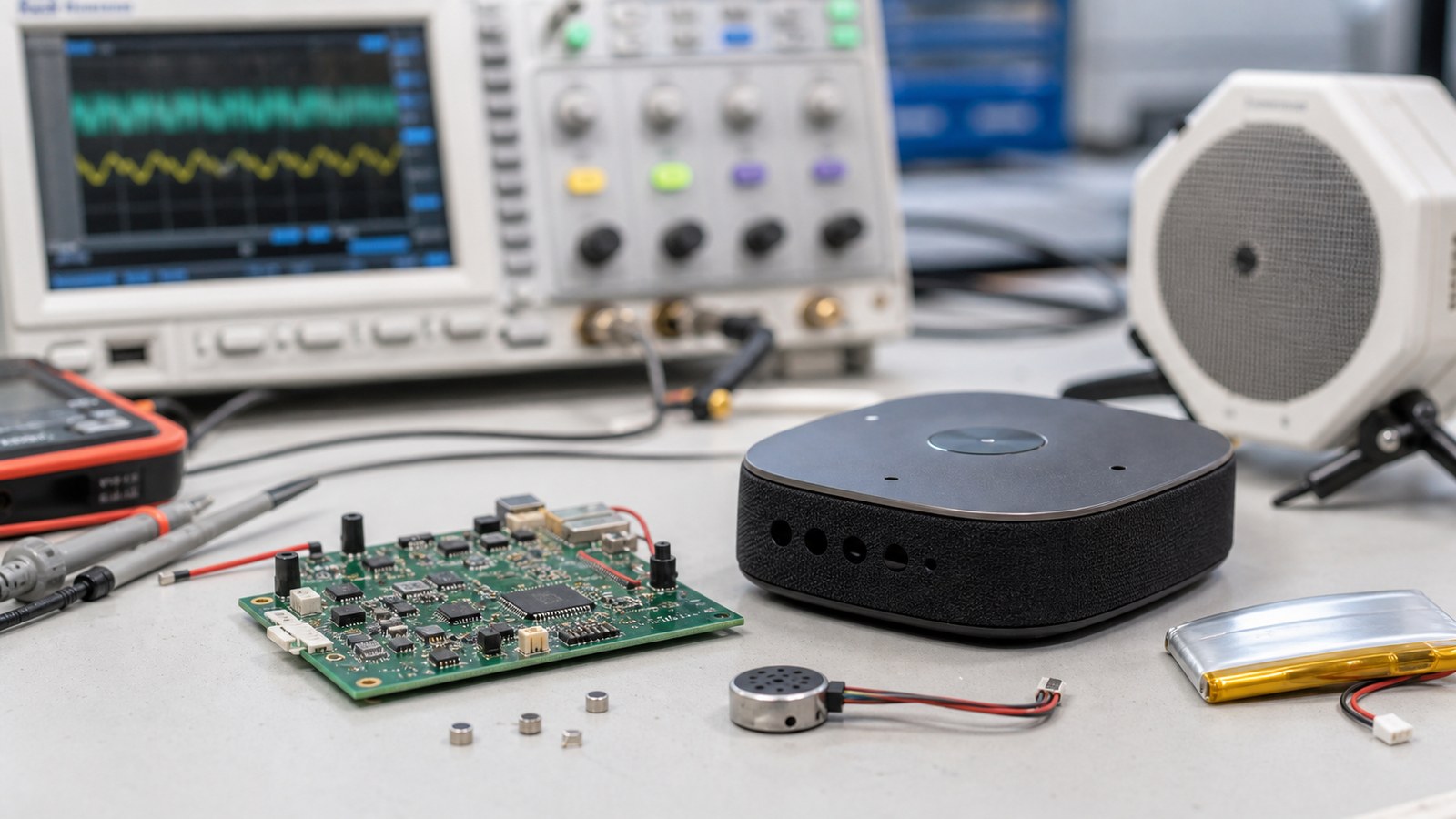
Voice activation sounds simple to users. They say a phrase, the product wakes up, and the next action begins. For the hardware team, a low power wake word device is much more than a microphone and a software model. It is a system-design decision that affects the processor, audio path, enclosure, battery, BOM, testing plan, privacy expectations, and manufacturing process.
This matters because products that respond to phrases like “hey siri” or “hey alexa” are expected to feel instant while using very little power. If the main processor stays awake all day, battery life suffers. If the wake-word model is too weak, the product misses commands or wakes at the wrong time. If the enclosure or microphone placement is poor, the best algorithm can still perform badly in real homes, shops, vehicles, or industrial environments.
For product companies developing voice-activated AI hardware, the goal is not just to add a wake word. The goal is to build an always-ready product that can be manufactured reliably at the right cost.
What a Wake Word Device Actually Does
A wake word device listens for a short phrase before activating the main application. The wake phrase may be a branded phrase, a custom command, or a product-specific phrase. After detection, the product may wake a larger processor, start local command recognition, connect to a cloud service, or begin an AI / LLM interaction.
In a well-designed product, the always-listening part is usually kept as small and efficient as possible. The system may use a low-power microcontroller, DSP, neural processor, audio codec, or dedicated wake-word chip to monitor audio while the main processor remains asleep or in a lower-power state.
This approach allows the product to feel available without keeping the entire system active all the time.
Why Low Power Is a Hardware Architecture Problem
Wake-word power consumption is not controlled by one component. It depends on the full audio and compute chain:
- Microphone type and quantity
- Audio codec or front-end processor
- MCU, DSP, NPU, or wake-word accelerator
- Memory required for the model and audio buffers
- Clocking and sleep-state behavior
- Battery size and power-management design
- How often the main processor wakes
- Whether speech recognition runs locally, in the cloud, or both
A common mistake is to treat wake-word detection as a software feature that can be added late. In reality, the wrong hardware platform may create unacceptable power draw, poor microphone performance, limited model support, or higher BOM cost after the product is already designed.
Common Architecture Options
There are several ways to build wake-word hardware. The right choice depends on product cost, expected battery life, language support, recognition accuracy, privacy requirements, and whether the product needs offline commands or LLM integration after wake-up.
| Architecture | Best Fit | Main Tradeoff |
|---|---|---|
| Low-power MCU | Cost-sensitive products with simple wake-word or local command needs | Limited memory and model size |
| DSP or audio processor | Products needing stronger always-on audio processing | More integration work and supplier dependency |
| Dedicated neural / wake-word accelerator | Battery-powered products where always-on power is critical | Additional BOM line item, but often better power efficiency |
| Main application processor only | Plug-in products or devices where power is less constrained | Usually not ideal for battery-powered always-listening products |
For many commercial products, the best architecture is a staged approach: a very low-power audio path detects the wake word, then wakes a larger processor or communication module only when needed.
On-Device Wake Word vs Cloud AI
Wake-word detection should usually happen on the device. Sending all audio to the cloud before wake-up can increase power use, create privacy concerns, require constant connectivity, and make the product feel unreliable when the network is weak.
That does not mean the whole AI experience must run locally. A practical voice-activated AI product may use:
- On-device wake-word detection
- Optional on-device command recognition for simple actions
- Cloud speech recognition or LLM processing after the device wakes
- Local fallback behavior for basic controls when the network is unavailable
This split is especially important for AI integrated products with LLMs. The wake word should be fast and efficient. The LLM interaction can happen after the user intentionally activates the product.
Microphones and Enclosure Design Matter
Wake-word accuracy is not just an algorithm score. The physical product affects recognition. Microphone placement, port size, gasket design, waterproofing, speaker echo, fan noise, enclosure resonance, and distance from the user can all change performance.
Products that include speakers may need acoustic echo cancellation so the device does not confuse its own audio output with the user’s voice. Products used in retail, vehicles, kitchens, warehouses, or outdoor environments may need noise suppression, voice activity detection, or microphone-array decisions early in development.
This is why mechanical design, acoustic design, PCB layout, and firmware should be reviewed together before tooling starts.
BOM Optimization for Wake Word Products
The lowest-cost BOM is not always the lowest-risk BOM. For a wake-word product, cost optimization should consider both component price and system performance.
Important BOM questions include:
- Can the chosen MCU or processor run the required model with enough memory margin?
- Is a dedicated audio or neural processor cheaper than using a larger main processor?
- Does the microphone meet the noise, sensitivity, and enclosure requirements?
- Can the battery meet the target standby time with realistic wake events?
- Does the product need Wi-Fi, Bluetooth, 4G, or another connection after wake-up?
- Will certification requirements affect wireless module selection, antenna design, or enclosure materials?
For volume manufacturing, these decisions should be reviewed before the design is frozen. Small changes to the audio path, module selection, or enclosure can affect cost, test yield, and user experience.
Testing a Low-Power Wake Word Device
Prototype testing should go beyond “does it wake up on the bench?” A useful test plan should include real product conditions.
- Wake accuracy at different distances and speaking volumes
- False accepts when TV, music, background speech, or machine noise is present
- False rejects across expected accents, languages, and user types
- Wake latency from phrase to response
- Power consumption in listening, wake, processing, connected, and sleep states
- Battery life under realistic daily usage
- Performance after enclosure tooling, gasket changes, or waterproofing changes
- Production-line test method for microphone, speaker, button, wireless, and wake response
Testing should also define what happens after wake-up. If the product connects to an LLM, cloud service, mobile app, or 4G network, the wake-word experience is only the first part of the user journey.
Manufacturing Checklist for Voice-Activated AI Products
- Define the target wake phrase, languages, noise environments, and acceptable false-wake rate.
- Choose the hardware architecture before PCB and enclosure design are locked.
- Validate microphone placement with the real enclosure, not only with an open development board.
- Measure power in every operating state, including standby and post-wake processing.
- Review whether the product needs local commands, cloud AI, LLM integration, or offline fallback.
- Optimize the BOM around performance, availability, certification, and production yield.
- Build a production test plan for audio, wake response, wireless, battery, and final assembly.
- Plan certifications early if the product includes wireless, chargers, batteries, or export-market requirements.
How Emszen Can Help
Emszen supports electronics product development and manufacturing from Shenzhen, China. For voice-activated and AI-connected products, the team can help connect practical design decisions with PCB fabrication, SMT assembly, enclosure and tooling considerations, BOM optimization, testing, and volume manufacturing planning.
That matters for low-power wake-word hardware because the product experience depends on more than software. The microphone, PCB, enclosure, processor, battery, wireless module, test process, and cost target all need to work together.
Developing a Voice-Activated AI Product?
Share your product idea, power target, expected wake phrase, connectivity plan, BOM status, or prototype files. Emszen can help review the practical hardware and manufacturing path for your low-power wake word device.
FAQ
Can a wake-word device run without the cloud?
Yes. Wake-word detection can run on the device using an MCU, DSP, neural processor, or dedicated wake-word solution. More advanced speech recognition or LLM features may still use the cloud after the device wakes.
What affects battery life in an always-listening product?
Battery life depends on the microphone path, processor choice, model size, sleep states, wake frequency, wireless activity, speaker use, and how long the main processor stays active after each wake event.
Should a voice-activated product use an MCU, DSP, or AI accelerator?
It depends on cost, power target, model complexity, memory needs, offline command requirements, and production volume. Battery-powered products often benefit from a low-power always-on audio path instead of keeping the main processor awake.