
Short answer for a busy product manager
A production test fixture is a dedicated tool used on the factory line to check, program, calibrate, and log every device before it ships. Choosing whether to invest in a production test fixture affects your time to market, the hands-on work your team must do, and how smoothly quality holds up as volumes grow.
Which option gets my product to market sooner?
Choosing a lightweight bench test gets you to the first small runs faster, while a full production test fixture favors predictable scaling. If you only need a few prototypes or pilots, a simple hand test and occasional firmware flashing is often quickest. If your plan includes ongoing production, a production test fixture reduces manual steps that would otherwise slow inspection and final assembly.
When do I need a production test fixture?
When you expect repeatable manufacturing beyond a handful of units, a production test fixture becomes the right choice. A fixture is the right call when manual actions are taking engineer time, firmware flashing is inconsistent, calibration drifts between units, or serial tracking is hard to maintain.
What a production test fixture actually does on the line
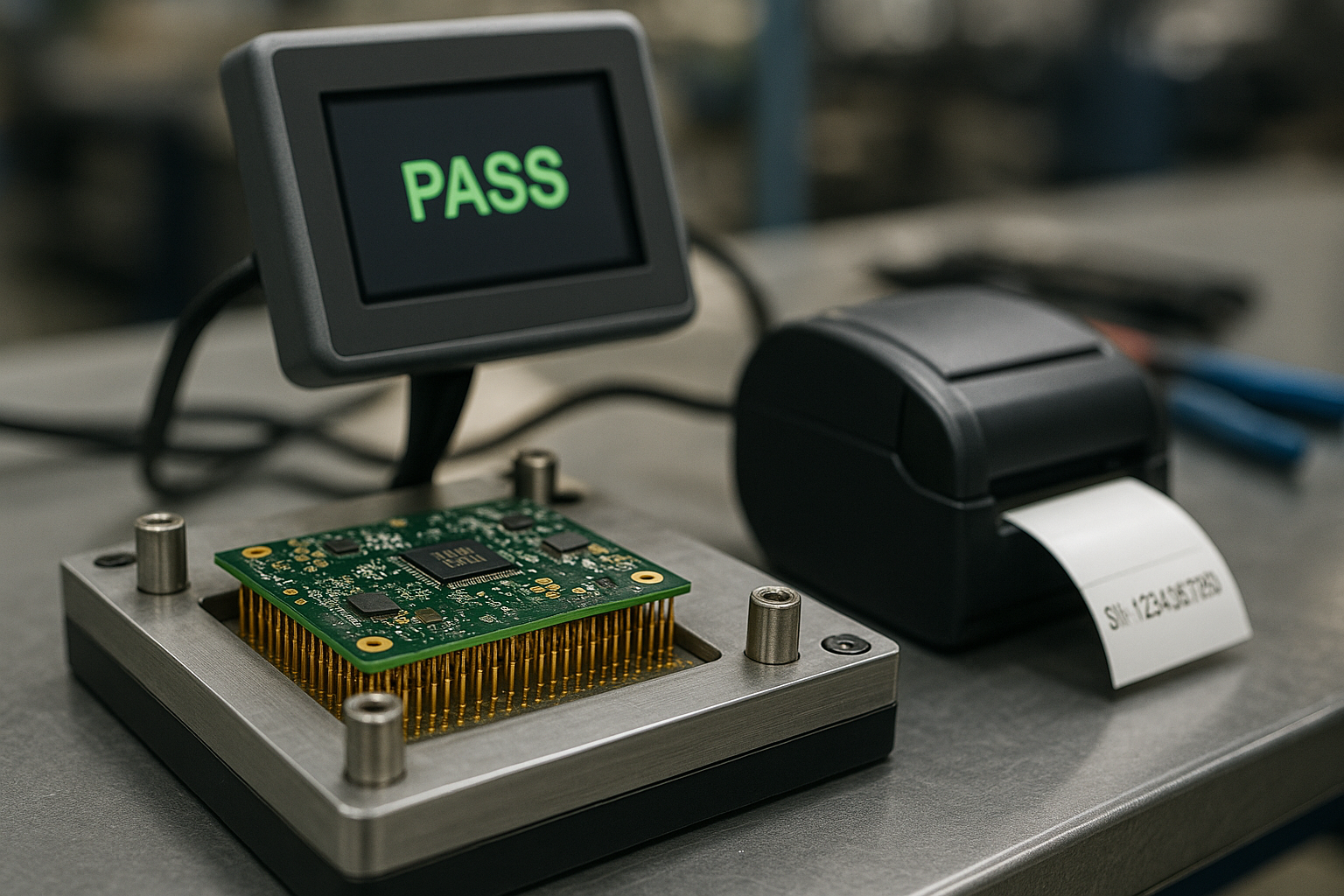
A production test fixture brings several tasks together in one repeatable flow. Typical functions are:
- Pogo-pin beds that contact test points on the board for quick electrical checks and programming. A pogo-pin bed is a spring-loaded contact array that touches test pads without soldering.
- Button, audio, and sensor checks to confirm user inputs and environmental responses work as expected.
- Firmware flashing and verification, so every unit runs the correct software before leaving the line.
- Calibration routines for sensors or radios, performed automatically with guided steps where needed.
- Pass or fail logging and serial number labels to link each physical unit to its test record for traceability.
How a fixture saves time and reduces manual work
A production test fixture turns fragmented tasks into a single operator flow, which means fewer human errors and faster throughput. When flashing firmware, running functional checks, and printing a serial label are combined in one station, an operator follows a short, repeatable script instead of juggling multiple tools and spreadsheets.
Decision framework – which approach fits your stage
| Option | Best for | Tradeoff |
|---|---|---|
| Manual bench testing | Very early prototypes and iterative debugging | Fast to start, manual effort grows quickly with volume |
| Basic fixture or jig | Pilot runs and low volume where some repeatability is needed | Lower setup than a full fixture, limited automation |
| Full production test fixture | Ongoing production, predictable quality, and traceability | Longer setup, but reduces operator time and scaling risk |
How we handle fixtures in a real build
We treat fixture development as part of the manufacturing sequence, not a separate purchase you must manage. First we map the tests your device needs, then we design a fixture that groups those tests into a single operator flow. We prototype the pogo-pin bed and electrical checks, build the functional test sequence for buttons and sensors, then add firmware flashing and automatic labeling. During the first production runs we refine the fixture to cut operator steps and reduce rework.
What you will see from our side
From your perspective, you get clear milestones: prototype test runs, a fixture review, pilot production, and then the move to steady production. We handle the technical tradeoffs, so your team only needs to approve the test goals and sign off on sample units.
What influences the size and complexity of a fixture
The fixture you need depends on the device functions you must verify and how automated you want the station to be. Devices with radios, sensors, or mechanical buttons usually need additional checks and calibration steps. If you want automated serial number printing and database logs, that adds integration work but makes traceability effortless. These are design choices based on expected volumes and how much operator time you want to avoid.
FAQ
Do I need a production test fixture for prototypes?
Not usually. For early prototypes, simple bench tests and manual firmware flashing are faster. A production test fixture becomes the right choice when you move from prototype to repeated production and want consistent checks and traceability.
Can a fixture handle firmware flashing and calibration automatically?
Yes. A production test fixture can run firmware flashing, verify the install, and then run calibration routines. Those steps are combined so the operator follows one flow rather than multiple tools.
What is a pogo-pin bed, and why does it matter?
A pogo-pin bed is an array of spring-loaded contacts used to touch test points on a circuit board without soldering. It matters because it lets the fixture check electrical signals and program devices quickly and reliably on the line.
How does pass and fail logging work?
Pass and fail logging records each unit test outcome and links it to a serial number label or QR code. That creates a searchable history for each device without manual spreadsheets.
How long does fixture development take?
Fixture development is scheduled as part of the manufacturing plan and refined during pilot runs. We size the timeline to your launch plan so it supports your milestones without adding unnecessary delays.
Next step – talk with a Shenzhen-based partner who builds these
If you want a clear recommendation for your product, our team at Shenzhen Futurezen Co. Ltd. can map the test requirements to a fixture option that matches your timeline and production plan. Contact our manufacturing team to discuss your prototype, desired checks, and how we can include firmware flashing, calibration, and pass/fail logging in a single station. Visit our services page at /services/ or get in touch via /contact/ to start the conversation.