
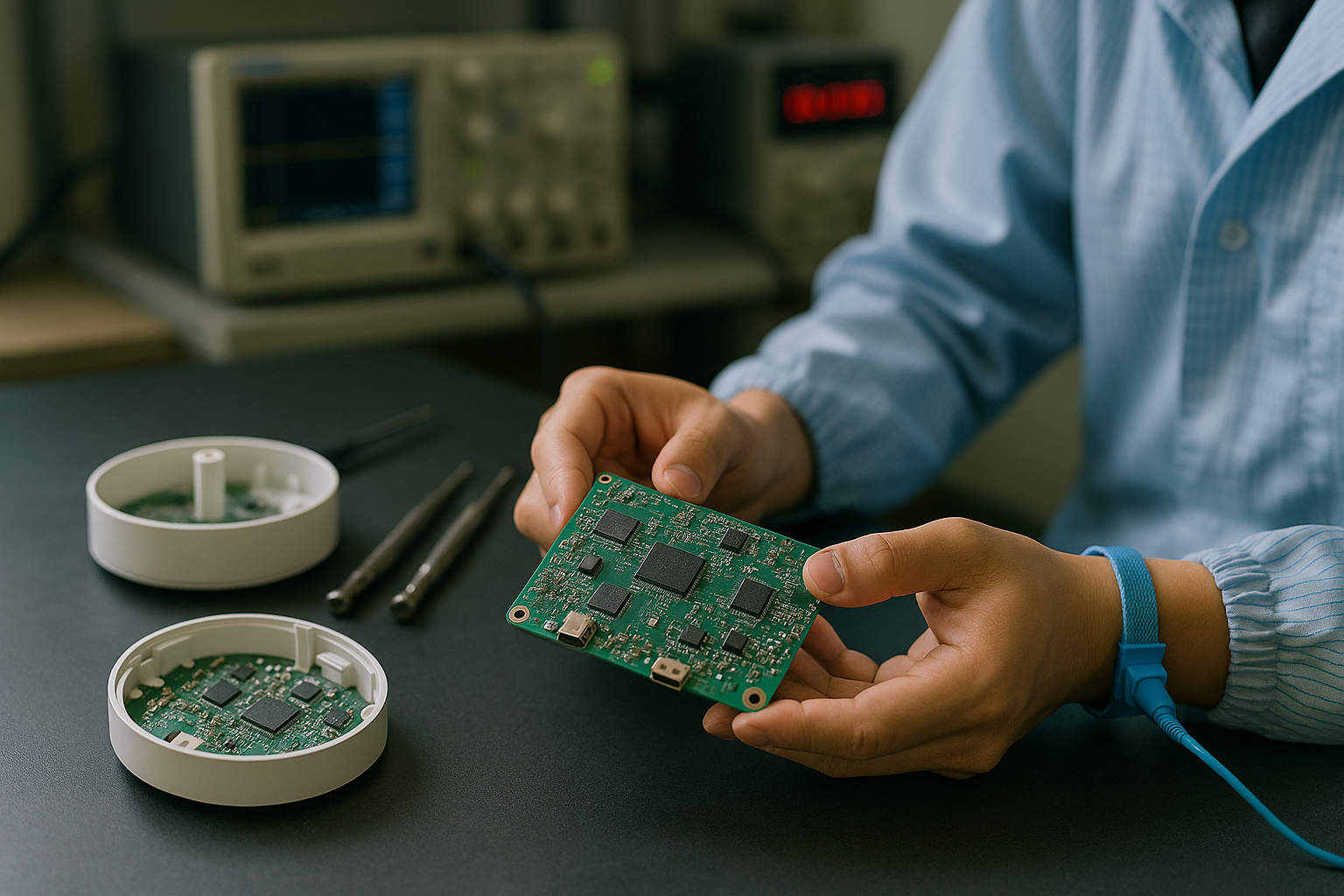
Deciding the path decides your schedule and product outcome
Deciding whether to use off the shelf parts, a fully custom design, or a hybrid approach determines your schedule, product differentiation, and development risk for smart home device manufacturing. That decision is the primary tradeoff a product owner must make, and it shapes which milestones you see and which questions we handle for you.
What changes between off the shelf, hybrid, and custom options?
Picking a path changes three practical things: how fast you get a working prototype, how many parts choices you review, and how many certification steps we must plan. Off the shelf parts get you to a prototype quickly with fewer unknowns. Fully custom design gives more control over size and user experience but takes longer. A hybrid approach is a middle ground, keeping a predictable schedule while allowing one or two unique product features.
Which option gets my product to market sooner for smart home device manufacturing?
If your priority is the earliest viable launch, off the shelf wireless and sensor modules usually shorten the schedule. A hybrid approach is the most common choice for startups that need a clear delivery date while keeping a distinct feature. Fully custom electronics are right when the product must meet specific size, battery life, or performance goals that off the shelf parts cannot meet. We always frame these as tradeoffs, not absolutes, and sequence work so each milestone delivers learning.
How do we make these tradeoffs into a plan you can rely on?
We translate your product goals into a simple staged plan. First, we agree the minimum features for the first launch. Second, we select parts and modules that meet those goals and lock a core parts list for the prototype. Third, we build a physical prototype with an emphasis on enclosure fit, user flows, and basic reliability. Finally, we refine parts and move to factory checks and lab testing needed for certification. Throughout, we keep decisions tied to outcomes like time to launch and product differentiation rather than technical detail.
What factory testing and reliability work will you see for smart home device manufacturing?
Factory testing is organized so you see clear progress without needing to manage technical details. We run functional checks that confirm the device performs to the agreed feature set, then environmental and reliability checks that demonstrate expected life, and finally packaging and programming checks. Tests are defined around the parts list and the user flows you approved. Your team reviews test outcomes and acceptance notes, while our manufacturing team handles execution and vendor coordination.
- Decide minimum features and target certifications.
- Select off the shelf modules for fast prototype or custom parts for product goals.
- Build prototype, test connectivity and enclosure interactions, validate app flows.
- Run reliability tests in the factory, refine the parts list, then prepare certification submissions.
What decision areas affect schedule, handoff, and certification?
Below are the pragmatic choices that change who does what and when the questions land on your desk. We use these headings to focus discussions with your product team, and we take responsibility for the technical steps that follow.
- Sensors – Off the shelf sensor modules reduce design time and calibration work. If sensing is a core differentiator, we plan extra prototype and validation steps so you keep predictability.
- Wireless connectivity – Choosing pre certified wireless modules shortens radio testing. If you choose a custom radio path, we sequence radio work earlier so it does not block later milestones.
- Power – Standard battery and charging options simplify production and testing. If battery life is a product differentiator, we schedule additional validation runs while keeping a prototype milestone on track.
- Enclosure materials and flame rating – Picking a commonly used flame rated material speeds sourcing and approvals. If a special material is required, we fold material validation into the prototype timeline.
- User controls and indicators – Off the shelf assemblies reduce assembly and test complexity. Custom user interface work is planned as part of the prototype refinement stage.
- App and cloud approach – Early agreement on whether the device uses a local hub, direct cloud connectivity, or a mix affects parts and test sequencing. We stage firmware programming and cloud validation so app testing happens early in the factory flow.
Decision framework – how the approaches compare
| Approach | Time to market | Technical involvement | Who handles sequencing |
|---|---|---|---|
| Off the shelf modules | Shortest | Light | Factory and Futurezen handle details |
| Hybrid customisation | Moderate | Moderate | Futurezen coordinates refinements |
| Fully custom design | Longest | Higher | Futurezen leads development and validation |
How certification work changes when you use pre certified modules
Using pre certified wireless modules reduces the scope of radio certification in many cases because the radio element has already been tested. The finished product still needs to show the module performs correctly inside your enclosure and that the complete device meets safety rules. We coordinate parts, lab testing, and paperwork so certification proceeds alongside final firmware and packaging. For official guidance on equipment authorization please see the FCC equipment authorization pages at https://www.fcc.gov/engineering-technology/laboratory-division/general/equipment-authorization.
How we work with your team so decisions do not slow you down
We act as your Shenzhen based product and manufacturing partner, turning decisions into a short plan with clear milestones. We prepare a brief decision memo that explains tradeoffs, build the prototype, run factory checks, and sequence the lab testing needed for certification. If you want more detail on our engagement model, see our services page for typical offerings and handoffs.
FAQ
How do I choose sensors without being an engineer?
Choose sensors by the user outcome you need and how much calibration you want the factory to handle. If speed to prototype matters, well supported off the shelf sensor modules are a practical choice. If sensing performance is central to the product promise, plan for a refined prototype and extra validation runs.
Will using a pre certified wireless module limit my product?
A pre certified module reduces radio testing but does not remove the need to validate the finished device. It is a pragmatic approach in smart home device manufacturing when you want to reduce schedule risk while keeping enclosure and firmware flexibility.
What does enclosure flame rating mean for production?
Enclosure flame rating is a material classification relevant to safety approvals in many markets. Choosing a common flame rated plastic shortens sourcing and validation time. Our team advises on materials and manages the needed material testing steps.
How are app and cloud flows tested in the factory?
App and cloud flows are staged, starting with local connectivity checks, then test cloud instances, and finally production cloud validation. The factory programs firmware, runs scripted app scenarios, and reports results so issues are found before packaging.
What is the next step if I want a production plan?
If you want a clear plan that balances schedule and product quality, Shenzhen Futurezen Co. Ltd. can prepare a short decision memo and prototype plan tailored to your product. We handle parts selection, prototype builds, factory testing, and certification sequencing so your team stays focused on product and market decisions. Contact our team at /contact/ to discuss your prototype and manufacturing plan.