
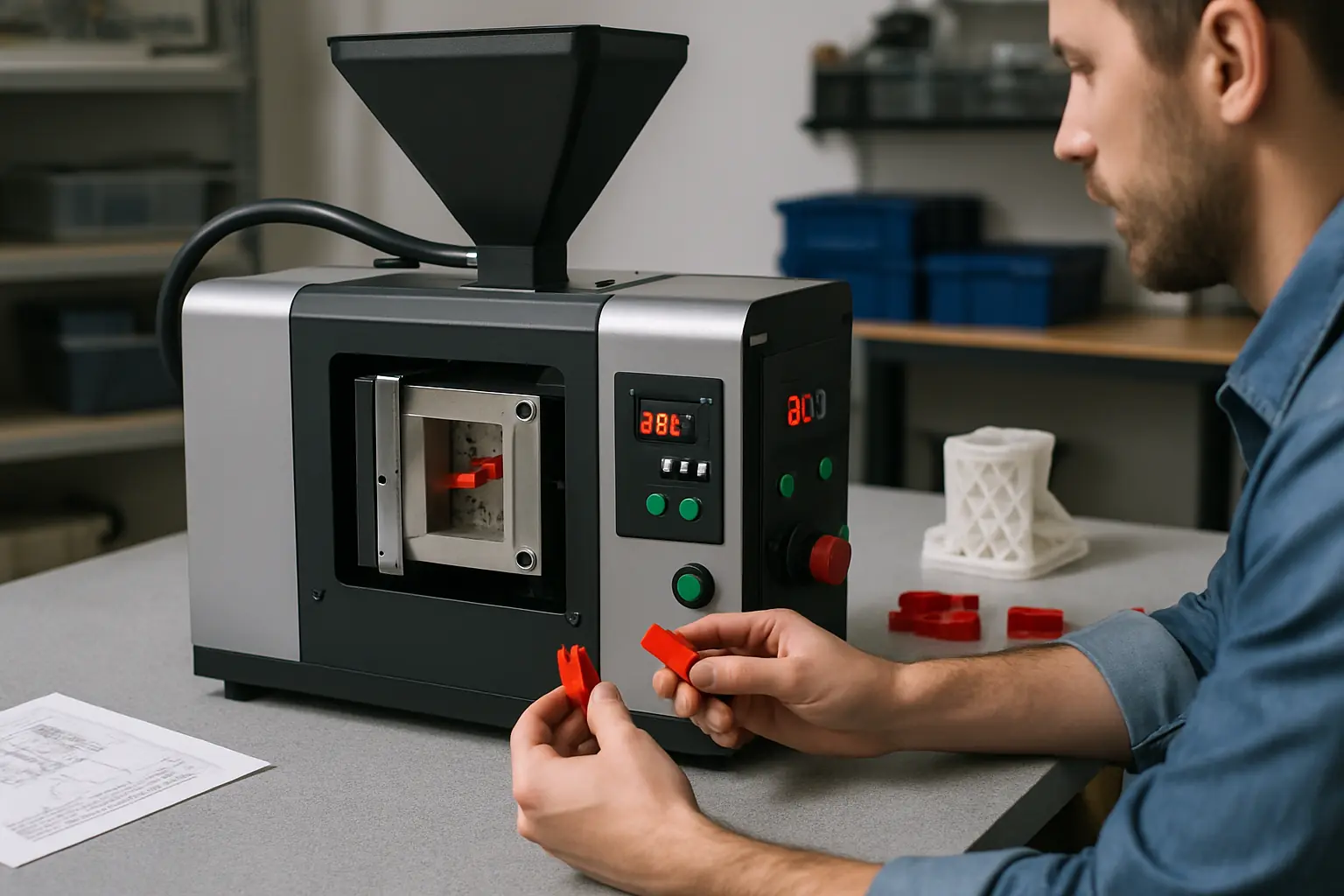
Desktop injection molding machines: when to use them and how they fit product development
Choose a desktop injection molding machine when you need production-grade plastic parts without committing to full production tooling. For product teams, these machines are a practical bridge between 3D printing and traditional injection molding: they deliver faster cycle times, molded surface finish and material properties closer to volume production while keeping tooling complexity and lead times low.
What a desktop injection molding machine does
Desktop injection molding machines are compact presses that inject molten thermoplastic into small, often modular molds. They use lower-tonnage clamping and smaller shot sizes than shop-scale presses, which reduces machine footprint and tooling cost. Typical uses are functional prototypes, user-testing parts, small pilot runs, and low-volume products where full steel tooling is not yet justified.
Common use cases for hardware product teams
- Prototype parts that need production-like material, strength and finish for functional testing or certification pre-checks.
- Small production batches or pilots where volumes are in the low hundreds to low thousands per year.
- Design validation of snap-fits, threads, and assembly features before investing in hardened steel molds.
- Insert molding for integrating threaded metal bushings, PCB standoffs or bonded components into a molded part.
Materials and molds
Desktop presses commonly process standard thermoplastics such as ABS, polycarbonate, polypropylene and engineering blends, plus flexible materials like TPU depending on the machine. Molds for desktop machines range from soft aluminum tooling to CNC-machined or modular steel inserts. Aluminum reduces cost and lead time but wears faster; steel inserts extend life and more closely replicate production molds.
Design and manufacturing considerations
- Keep wall thickness and rib design consistent to avoid sink and warpage; desktop molds are less forgiving than high-tonnage production tools.
- Plan draft angles and parting lines for easy ejection and minimal post-processing.
- Use venting and gate placement strategies that reduce burn and ensure complete fill at lower injection pressures.
- For assemblies with electronics, design for overmolding and insert molding to protect PCBs, reduce part counts and simplify assembly.
When desktop molding is not the right choice
Desktop molding is not a substitute for full-volume production tooling when long-term unit cost, tight dimensional control, or very high cycle counts are critical. For tens of thousands of parts or where the part requires complex multi-cavity hardened steel tooling and automated handling, traditional injection molding lines are the appropriate next step.
Quality, testing and scale-up
Use desktop-molded parts for functional testing, fit and finish checks, and to validate assembly processes. When transitioning to production tooling, expect to refine gate locations, cooling channels and material grades to match high-volume cycle times and tolerances. Prototype molds can be designed so critical features transfer to production tooling with minimal rework.
Selecting a partner or in-house approach
Decide between in-house desktop molding and a contract partner based on expected frequency of runs, the need for engineering support, and integration with other manufacturing steps such as PCB assembly and final device testing. A manufacturing partner can provide design-for-manufacture guidance, mold-making, insert molding capability and a clear scaling path from aluminum prototype molds to hardened production tools.
Practical checklist for product managers
- Define target run sizes and acceptable part quality for prototypes versus production.
- Identify the material families you need (rigid vs flexible) and confirm machine compatibility.
- Decide whether inserts, overmolding or two-shot features are required.
- Plan how prototype parts will be used: functional testing, certification, user trials or pilot sales.
- Confirm partner capability for scaling to hardened tooling if production volumes increase.
If you want to evaluate whether desktop molding is the right step for your product, discuss your electronics manufacturing requirements, prototype or production plan with Futurezen.