
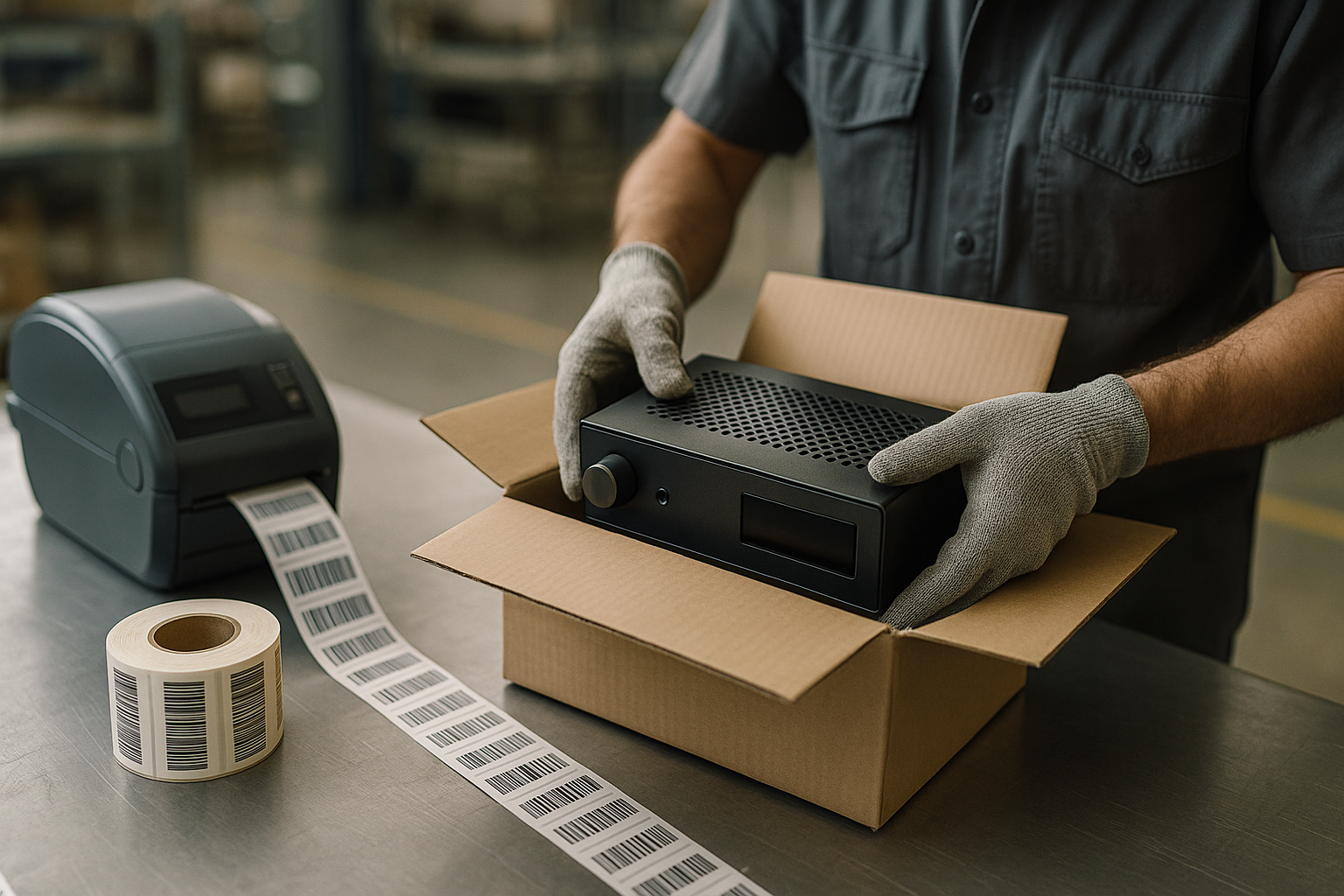
Quick answer: what to decide now and why it matters
Decide whether you need simple retail-ready packaging or a customised retail pack before your first production run, because that choice controls lead time, supplier coordination and how hands-on your team must be. At Shenzhen Futurezen Co. Ltd. we handle the technical work so you can focus on the user experience and channel requirements.
Which product packaging and labelling manufacturing option gets my product to market sooner?
Choosing a simple off-the-shelf box with standard labels gets a product to market sooner, while custom printed packs or complex labelling and serialisation add time. Simpler options reduce coordination with designers and suppliers, less pre-production proofing, and fewer late changes on the assembly line.
What changes between options, in plain terms:
- Supply chain complexity. Custom printed cartons require a separate supplier and a production proof, standard boxes do not.
- Quality checks. Complex labelling and serialized tracking needs more verification steps at final packing, standard labels need a simpler check.
- Project time. Custom art approvals and label proofs add time before the first shipment, while simple packing can be agreed during the first builds.
- Your team involvement. The more bespoke the pack and labelling, the more decisions and approvals your team must make early on.
What to plan for: labelling, serialisation and regulatory text
Plan labels and serialisation early because they touch product identity, warranty and channel compliance. A label is the printed information attached to the device or pack. Serialisation is a unique code for each unit that supports warranty, returns and some retail rules.
Decisions to make and why they matter:
- Label location and adhesion, choose a spot that is visible but does not interfere with assembly or testing.
- Data on the label, determine the exact product name, model, regulatory marks and where the serial number will appear.
- Format for serialisation, pick a human readable plus machine readable format if you expect retail scanning or batch traceability.
- Label printing method, decide between on-demand printing at the factory or pre-printed labels delivered with the product.
We will test label adhesion and scanability on a trial batch, then lock the specification before full packing.
Final packing and fulfilment for retail or online channels
Final packing is where the finished unit becomes a shippable product, with protective inserts, manuals, accessories and the retail pack. Choose packing driven by the channel: retail shelving needs presentation and carton strength, online channels need protection for transit and possibly inserts for direct-to-consumer unboxing.
Common choices and their implications:
- Retail display pack, choose this when shelf presence and unboxing matter; it requires stricter proofing and likely samples for placement testing.
- Transit-optimised pack, choose this when most units ship from warehouses to consumers; it focuses on protection and packing speed at final packing stations.
- Bulk packing for distribution, choose this when you ship pallets to distributors; it reduces per-unit packing time but adds unpacking work downstream.
| Option | Time to first shipment | Risk for first run | Your team involvement | When to choose |
|---|---|---|---|---|
| Simple box, pre-printed generic labels | Shorter | Lower | Low | Early market testing and tight timelines |
| Custom printed retail cartons, fixed design | Longer | Moderate | Medium | Retail launch and brand presentation |
| Serialized labels, on-demand printing at line | Depends on setup | Higher initial setup | High early then low ongoing | Warranty management and regulatory tracking required |
How we handle packaging and labelling on a real build
We sequence the work to keep decisions off the critical path for the product build. Early in the project we confirm the parts list and the physical dimensions of the finished product. That allows a packaging mock up to be produced while the first test units are assembled.
Typical sequence we follow:
- Lock product dimensions and connector access points so packaging fits the product without blocking use.
- Produce a sample pack and sample label proof for your approval. We run a scan test if barcodes or QR codes are used.
- Do a short run with final packing, the team inspects label adhesion and pack fit, then we sign off before ramping to larger volume packing.
This approach keeps the product build moving while finalising packing details, and it reduces last-minute rework on the assembly line.
Practical choices for small teams
If your team is small, favour simpler options early and layer in complexity as you validate demand. Choose pre-printed labels and a standard carton for the first production run, then move to custom printing and serialisation once the process is proven. That keeps your workload and approvals manageable.
What to prepare before the first design review
- Decide the legal product name and model code so regulatory text is final.
- Choose whether you need a visible serial number on the product and/or the pack.
- Gather any retailer requirements, such as barcode types or mandatory marking, so we can incorporate them into proofs.
Frequently asked questions
Do I need serialisation for online sales?
Not always. Serialisation is useful when you need individual unit traceability for warranty or returns. If you expect high volume returns or regulatory tracking, plan for serialisation. Otherwise you can add it later once volumes justify the setup.
Should I print labels in advance or at the factory on demand?
Print labels in advance if the text is fixed and you want a consistent finish. Use on-demand printing at the packing line if you need per-unit serial numbers or last minute batch codes. On-demand adds operational steps, but it avoids wasted pre-printed stock when designs change.
How do retail requirements change the packaging work?
Retail channels often demand specific carton strength, barcode placement and sometimes hang tabs or display features. Those requirements usually mean extra proofs and sample approvals. We coordinate with your retail specs so samples reflect real shelf conditions.
Next step
If you want a straightforward path, start with a simple pack and scope serialisation for a later phase. If brand presentation or retail launch is the priority, budget time for printed cartons and proofs. Either way our team in Shenzhen acts as the technical partner to make those choices executable.
Contact us to discuss your product packaging and labelling manufacturing needs, share your prototype or production plan, and we will outline the practical next steps and sample schedule. Visit our contact page at /contact/ to start the conversation.