
Direct answer – which verification depth should you choose and why it matters
Decide early how deep to test battery powered devices in production, because that decision shapes your launch schedule and the level of confidence in field performance. A fast acceptance pass keeps timelines tight and checks the essentials on every unit, while a fuller verification flow adds sample-based checks that reduce surprises after shipment. We handle the measurements and recommend sensible defaults so your team can make the tradeoff without getting into test details.
Which approach should I pick to test battery powered devices in production?
The right choice depends on what the product promises and what you can accept in schedule. Choose a quick acceptance pass when the battery supplier and design are proven and you need speed. Choose full verification when the battery chemistry, supplier, or power features are new, or when the product markets long battery life. We recommend the quick pass for most early production runs and add depth as features or volumes make it worthwhile.
What does a quick acceptance pass include versus full verification?
A quick acceptance pass verifies basic charging and discharge behavior, protection circuits, and that the unit powers on and meets essential functional checks. It is fast and performed on every unit so production keeps moving.
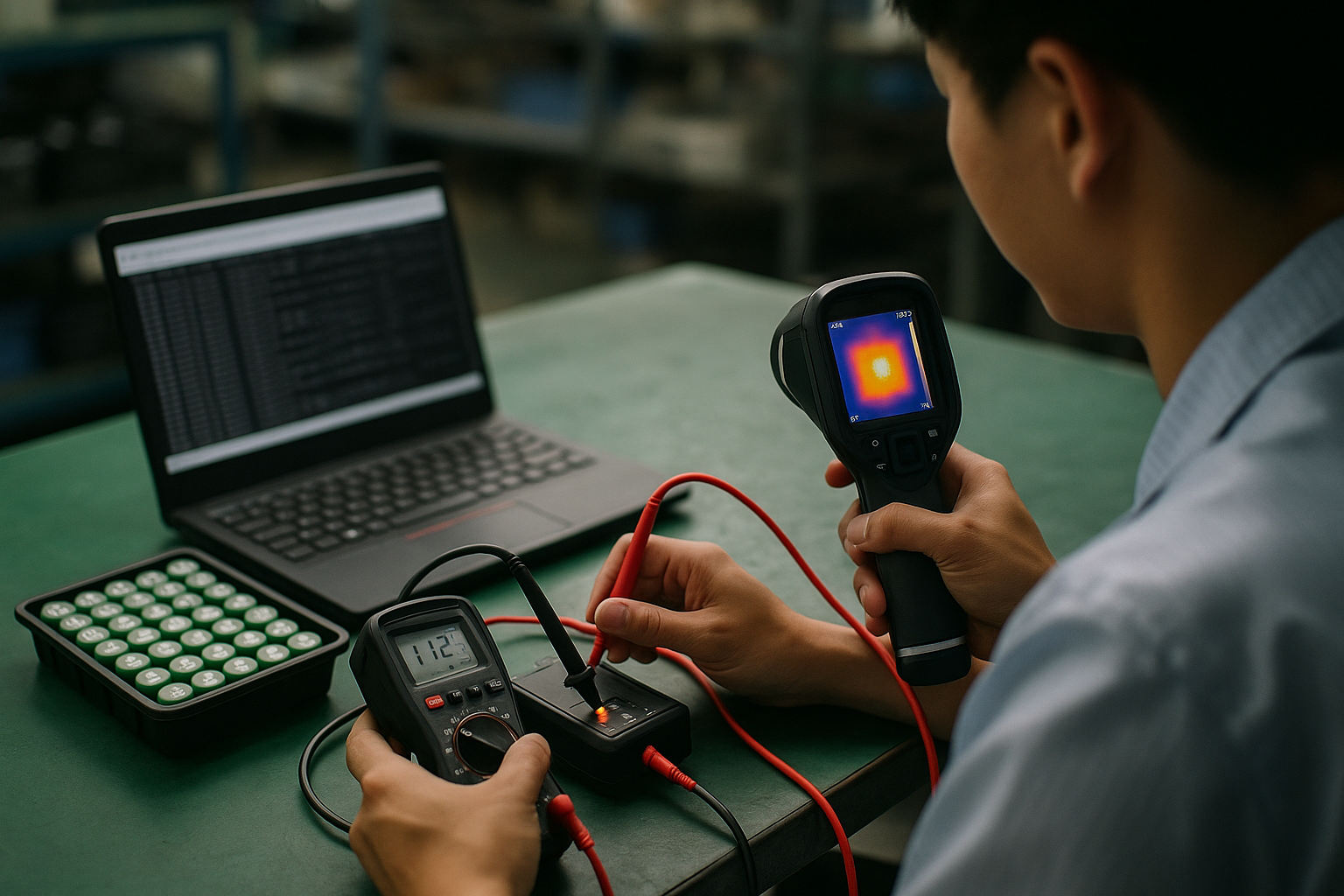
A full verification flow adds targeted sample tests that take longer but give higher confidence. Those tests include sleep current measurements, thermal profiling, extended load runs, fuel-gauge calibration, and aging cycles on a sample group. Fuel-gauge calibration is the simple process of aligning the device battery meter so the percentage it shows matches the actual remaining capacity. We schedule those deeper checks so they do not hold the main line except for the sample units under test.
How do we sequence these checks so manufacturing does not stall?
We sequence work to keep the assembly line moving and to provide results you can act on. First we do visual checks and a power-on smoke test. Inline charging and basic discharge checks run on each unit as the primary acceptance step. In parallel, we route batches of samples to longer checks for sleep current, thermal profiling, and load tests. Fuel-gauge calibration and aging cycles are performed on a controlled sample set, and results are reported back with recommended firmware or component updates if needed. If shipment is pending, we complete the agreed safety documentation and carrier checks without delaying normal dispatches.
What does this mean for your role and decisions?
You do not need to run the tests yourself. Pick the depth you want and the pass criteria, or accept our default plan and let us escalate only when data indicates a design or supplier change. We present clear decision points and findings, so you can approve firmware releases or supplier moves based on evidence rather than guesswork.
Which checks matter most for product behavior and customer experience?
Here are the main checks we run to test battery powered devices and why they matter for your launch.
- Charging and discharge checks: Confirms each unit accepts charge and runs under a representative load profile. This is the baseline for every unit.
- Sleep current and standby drain: Measures idle battery use so advertised standby life is realistic. Use this when long standby matters.
- Load tests and functional playback: Runs real workloads to find actual battery life and heat behavior, useful for new firmware or hardware changes.
- Battery protection and cutoff checks: Verifies protection circuits behave as intended. These checks support safe operation and consistent performance.
- Thermal checks: Observes temperature during charging, heavy use, and storage, which helps set shipping and operating guidelines.
- Fuel-gauge calibration: Aligns the device battery meter so remaining percentage matches actual capacity. We do this on samples and include calibration steps in firmware updates when needed.
- Aging samples: Runs charge-discharge cycles on a sample group to detect early life drift and trends that affect perceived quality.
- Shipment safety checks: Prepares packaging, labeling, and paperwork required by carriers, and stages cells so packaging and documentation are aligned with carrier requirements.
| Approach | When to choose it | What we run | Impact on timeline |
|---|---|---|---|
| Quick acceptance pass | Fast launch, proven battery supplier | Charging, basic discharge, protection check per unit | Minimal delay to market |
| Full verification | New design, new supplier, long-life claims | All checks plus sleep current, thermal, fuel-gauge calibration, aging samples | Longer schedule, higher confidence |
How do regulatory and shipment requirements fit into the plan?
Shipment safety is part of the verification flow, not an afterthought. We follow carrier rules and prepare documentation and packaging in step with testing. For formal carrier guidance see the IATA dangerous goods rules. Our team stages cells and aligns labeling and paperwork before a shipment is released.
When should we revisit the depth of testing?
Revisit the plan when the parts list changes, firmware alters power profiles, or customer expectations shift. If you change battery suppliers or add power-hungry features, we increase sample verification until the change is well understood. We schedule checkpoints so verification does not unexpectedly stall production, and we present clear options when adjustments are needed.
FAQ
How long does it take to test battery powered devices in production?
Timing depends on the approach. A quick acceptance pass runs inline with assembly and is fast. Full verification uses longer sample cycles for aging, thermal stress, and calibration, which takes more calendar time. We plan both options to avoid blocking the main line.
Do I need fuel-gauge calibration before shipment?
Calibrate when accurate battery reporting matters for customer experience, or when firmware or battery chemistry changes. We do calibration on representative samples during verification and add the step to pre-shipment procedures when needed.
Will shipment safety tests delay my release?
No, shipment safety tests are scheduled as part of final acceptance. We validate packaging and paperwork early so routine releases proceed as planned. If additional tests are required by carriers, we flag them and adapt the timeline without surprise delays.
How often do you re-run aging samples?
We re-run aging samples when you change battery suppliers, alter the parts list, or after firmware updates that affect power. For stable builds, aging is part of periodic verification on a sample basis rather than every production batch.
If you want to discuss which approach fits your launch, or to schedule testing for a prototype or production run, contact our team through contact or learn about our approach on our services page. Shenzhen Futurezen Co. Ltd. can shoulder the technical work and deliver clear decision points as we test battery powered devices in production.