
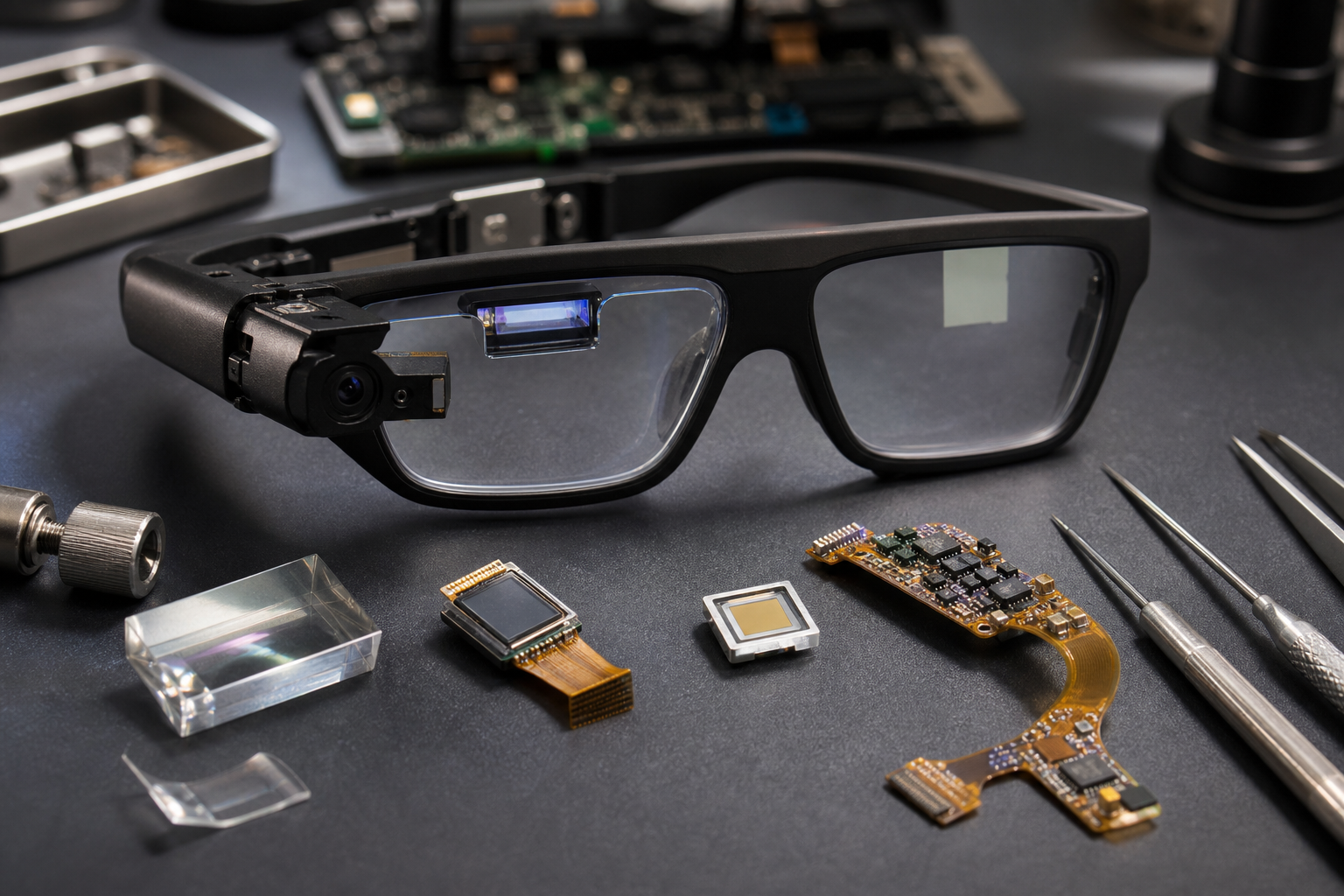
Introduction: smart glasses display technology for product teams
smart glasses display technology is the key choice that defines user experience, battery life, and manufacturability for AI eyewear. Hardware founders, product managers, and OEM buyers need a compact summary of the main optical approaches, their system tradeoffs, and what those tradeoffs mean for BOM, sourcing, and production in Shenzhen and beyond.
Main optical approaches and how they create an image
There are four practical ways most smart glasses get a screen into the glass. Each approach differs in where light is generated, how it is routed to the eye, and how visible the virtual image is within ambient environments.
1. Waveguides
Waveguides couple light from a microLED or micro-OLED projector into a thin optical substrate, then use diffraction gratings or holographic elements to extract the image into the eye. Waveguides offer the thinnest form factor and the most integrated look, with optics embedded into the lens or lens stack.
Strengths: thin profile, good see-through clarity, low visible bulk. Weaknesses: complexity in manufacturing, tight mechanical tolerances, limited native field of view in many implementations, high NRE for tooling and photomasks.
2. MicroLED or micro-OLED projection into optics
Here a tiny display panel projects an image, which is relayed by small lens blocks to the eye. Projection systems can use high-brightness microLED engines for outdoor use or micro-OLED for high contrast indoors.
Strengths: very high brightness possible with microLED, flexible optical layouts, easier display sourcing in some cases. Weaknesses: thermal load at the emitter, larger enclosure depth than waveguides, and more power draw if high brightness is required.
3. Birdbath optics
Birdbath optics use a small projector aimed at a partially reflective curved mirror that directs the virtual image into the eye while still letting the user see through. This is a common approach in early AR smart glasses prototypes and some enterprise devices.
Strengths: robust image quality, easier alignment for prototyping, relatively tolerant of display variations. Weaknesses: bulkier, visible optics, and limited aesthetic appeal for consumer products.
4. Combiner lenses and prism optics
Combiner lenses place an optical element in the line of sight that reflects a projected image toward the eye. Simple combiners can be low cost and fast to prototype, but they add thickness and often reduce transparency.
Key system tradeoffs to evaluate
Picking a display approach is not only an optics decision. It directly affects brightness needs, battery capacity, heat management, mechanical tolerances on assembly, supplier complexity, and certification risk. Below are the categories product teams must review early.
- Brightness and field of view (FOV), measured in nits and degrees respectively, determine outdoor visibility and immersion. Waveguides can be efficient for controlled brightness, while microLED projection gives the best raw nits for outdoor use.
- Heat and thermal design, especially with microLED engines. Higher brightness increases die temperature, which requires thermal paths, heatsinking, and can force more frequent firmware power scaling to protect user comfort.
- Battery impact, where display peak power can dominate runtime. Choose power budgets that match target use cases such as continuous AR navigation, short notifications, or intermittent AI overlays.
- Mechanical tolerances and alignment, waveguides and holographic elements require micron-class placement and flatness tolerances during lamination and assembly. That drives higher fixture cost and more stringent QA.
- Supplier choices and NRE, waveguide vendors often require larger NRE for optical design and tooling, while projector modules and combiners may be available from more modular component suppliers.
| Approach | Typical FOV | Brightness | Thermal load | Assembly tolerance | Best fit use cases |
|---|---|---|---|---|---|
| Waveguides | Low to medium (20 40 deg) | Moderate, efficient | Low to moderate | High, micron alignment | Consumer glasses, slim designs |
| MicroLED projection | Medium to high (30 60 deg) | Very high (good outdoor) | High, needs heatsinking | Moderate | Outdoor, heads up displays |
| Birdbath optics | Medium (25 45 deg) | High | Moderate | Moderate low | Enterprise AR, prototypes |
| Combiner lenses | Low to medium | Low to moderate | Low | Low | Cost sensitive, simple overlays |
Sourcing and manufacturing considerations
When you choose a display approach, align procurement, test engineering, and mechanical design. Practical steps include:
- Map supplier maturity, MOQ, and NRE, especially for custom waveguides or holographic gratings.
- Plan thermal validation early if using microLED projection, including thermal cycling and skin temperature tests.
- Design fixtures and alignment jigs for lens lamination and display-to-optic alignment, and budget for higher yield loss during initial runs.
- Verify supplier test data for brightness, color shift, and eye relief, and run your own optical bench measurements before committing to volume orders.
Mechanical and certification impacts
Optical choices affect enclosure thickness, ingress protection, drop performance, and EMC placement. High brightness light engines increase conducted and radiated emissions risks, so coordinate with EMI engineering for antenna placement for Bluetooth or cellular radios. Also confirm applicable safety standards such as eye safety testing for near-eye displays and relevant regional device safety rules. Teams should verify current regulatory requirements before certification planning.
Decision framework for product managers
Use this short framework when selecting a display path:
- Define key use cases: outdoor visibility, all day wear, or enterprise short sessions.
- Set power and thermal budgets based on battery size and target runtime.
- Rank aesthetic priorities versus development cost and time to market.
- Run feasibility builds with 1 2 suppliers for optics and display engines, and measure FOV, brightness, and thermal performance.
- Choose the supplier with acceptable NRE, test data, and production capacity in the target region.
FAQ – smart glasses display technology
Which display approach gives the biggest field of view?
Projection engines paired with optimized optics typically achieve the largest field of view. Waveguides can be engineered for wider FOV but at higher optical and manufacturing complexity.
How does display choice affect battery life?
Brightness is the main driver of display power. microLED engines at high nits consume significantly more power than passive waveguide-coupled displays. Factor display duty cycle into runtime modelling and consider power scaling and ambient light sensors.
Are waveguides ready for high volume manufacturing?
Waveguides are production ready but require upfront NRE for tooling and stricter assembly tolerances. Supplier selection and contract terms for photomask revisions matter. Verify yields on pilot runs before committing to volume.
What assembly risks should I expect?
Tolerances for lens flatness, glue thickness, and display placement can cause optical artifacts. Expect longer debug cycles for optical assembly, and plan automatic optical inspection and alignment tooling.
Next steps and CTA
If you are evaluating smart glasses display technology for an AI eyewear program, our Shenzhen based product development and manufacturing team can help with architecture choices, BOM impact analysis, supplier evaluation, and a certification plan. Contact Shenzhen Futurezen Co. Ltd. to discuss a practical prototyping and manufacturing roadmap, or request a feasibility call to review optics suppliers, thermal mitigation, and cost tradeoffs for your target volumes.
Next step
Share your product architecture, BOM priorities, certification path, prototype requirements, and sourcing constraints with Futurezen so the team can help plan the manufacturing path for How Are AI Smart Glasses Getting a Screen in the Glass?.