
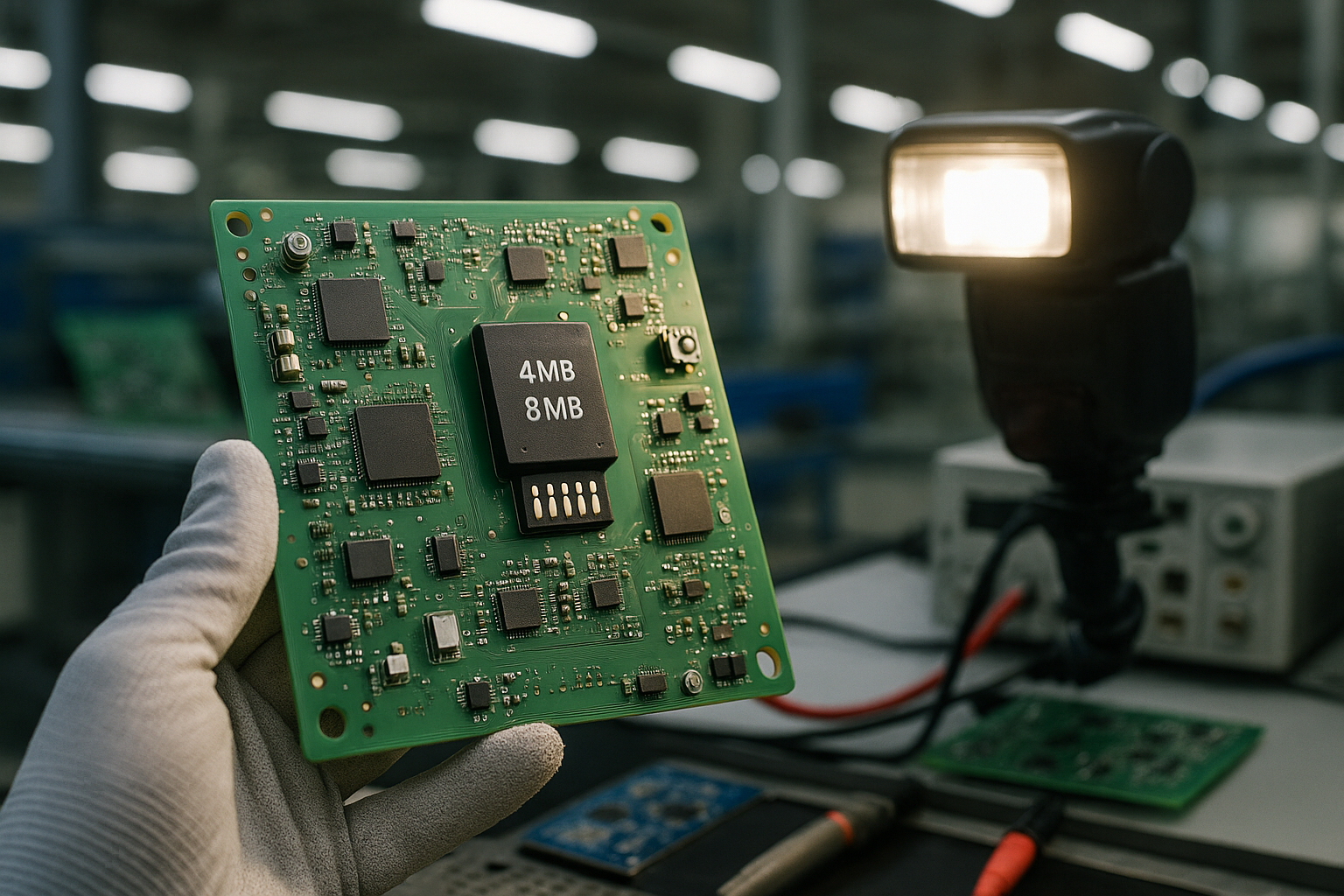
Choosing the right small external flash for a connected device is a common architecture and sourcing decision. This article explains when small external flash is enough for firmware assets, logs, OTA buffers, and product configuration, and how package, interface, reliability, BOM impact, and procurement planning affect that choice. It also explains how Futurezen, a Shenzhen based product development and manufacturing partner, can help teams source and validate suitable flash without promising fixed market pricing.
When 4MB or 8MB small external flash is sufficient
Many low power connected devices, NFC modules, Bluetooth peripherals, POS terminals, and simple camera or display controllers can use 4MB or 8MB of external SPI NOR flash. Typical uses that fit this size include:
- Firmware images for single MCU applications where compressed firmware is under 2.5MB to 6MB depending on compression and bootloader design.
- Configuration and calibration data, often just a few kilobytes to a few hundred kilobytes.
- Event or diagnostic logs stored in circular buffers for on device troubleshooting, usually a few hundred kilobytes.
- OTA staging buffers for delta updates, if splits and chunking are used to limit required buffer size to below the available space.
Key questions to validate if 4MB or 8MB is enough:
- What is the full firmware image size including bootloader and filesystem?
- Do you need A B rollback partitions or dual bank OTA?
- How much log retention do you need in the worst case?
- Will you expand features that add storage needs in the product lifecycle?
Package and interface choices for small external flash
For small external flash most teams choose SPI NOR because it is ubiquitous, simple to route, and supported by boot ROMs on many MCUs. Interface and package considerations:
- Interface: SPI standard, quad SPI (QSPI) and octal options trade speed for pin count. For small sizes, standard SPI or QSPI is most common.
- Package: SOIC, WSON, and UDFN are common for moderate volumes. WLCSP or WFVH may save board space but add assembly cost at low volumes.
- Voltage and IO levels: Match device IO voltage to avoid level translators. Many flash parts support 1.8V and 3.3V variants.
- Pin routing: Keep traces short and controlled impedance where possible for high speed QSPI lanes.
Reliability, endurance, and data integrity
Even small external flash must satisfy reliability needs. Key points to check in the datasheet and design:
- Endurance per block, measured in program erase cycles. For devices that write logs frequently, select parts with higher endurance or implement wear leveling at the software layer.
- Data retention specification, typically 10 years or more for NOR flash, verify for your temperature range.
- Error detection and correction. Small NOR memories often rely on software ECC, CRCs, or filesystem level checks. Plan for corruption recovery and power loss scenarios.
- Qualification grades. Commercial, industrial, and automotive grades differ in temperature and screening. Choose grade appropriate for your product environment.
BOM impact and cost considerations
Small external flash affects BOM in several ways beyond unit price:
- Component cost per piece, which varies with density, package, and grade. Higher density parts often have better price per bit but may have higher unit price.
- PCB area and assembly cost, especially if choosing a smaller package like WLCSP which may increase assembly complexity and yield risk at low volumes.
- Tooling and inventory carrying cost for multiple SKUs if you plan alternative parts for supply risk mitigation.
- Test and programming cost. Onboard flash may require programming in production or external programming depending on boot strategy.
Decision framework: matching use case to flash size and features
| Use case | Minimum recommended size | Key features |
|---|---|---|
| Simple MCU firmware, single image | 4MB | SPI NOR, standard temp grade, basic ECC at software level |
| Firmware plus logs and small OTA buffer | 8MB | QSPI optional, consider dual bank OTA planning, wear management |
| Dual bank OTA, rollback, or filesystem | 16MB or more | QSPI, consider higher endurance, testing for update robustness |
Procurement and supply planning
Procurement for small external flash must balance target BOM price with supply risk:
- Define primary and qualified alternates early. Cross reference JEDEC IDs and common footprints to allow last minute swaps.
- Plan lead times and minimum order quantities. Verify lead times with suppliers and include buffer stock for ramp phases.
- Avoid assuming static market pricing. Flash prices can change due to wafer capacity and demand. Verify current quotes before committing to a long term contract.
- Build procurement test samples and run production pilot runs to confirm programming, assembly yield, and firmware behavior on the final part.
How Futurezen can help
Futurezen is a Shenzhen based product development and manufacturing partner that can help teams evaluate architecture tradeoffs, validate that 4MB or 8MB small external flash is sufficient, and build a pragmatic sourcing plan. Typical ways we help:
- Evaluate firmware and OTA partitioning to fit into a target flash size and reduce BOM cost.
- Recommend package and interface choices consistent with assembly capabilities and volume targets.
- Source multiple qualified vendors, run supplier verification tests, and support pilot programming and test fixtures.
- Provide guidance on BOM optimization without promising fixed market pricing, and help teams verify current market quotes before purchase.
Practical next steps
If you are deciding between 4MB and 8MB flash, create a simple storage budget that lists firmware sizes, calibration, log retention, and OTA staging needs. Prototype with the smaller option when possible, and keep an alternate part plan for supply resilience.
FAQ
Is 4MB small external flash enough for OTA updates?
It can be, if your OTA strategy uses delta updates, chunked downloads, or in place patching. For dual bank OTA or full image staging, 8MB or larger is safer. Test your OTA flow under worst case conditions before committing to a size.
How do I handle power loss when writing to small external flash?
Use transactional write patterns, CRCs, and an atomic state machine for critical data. Implement a robust bootloader that can detect partial updates and rollback safely.
What packaging should I choose for low to mid volumes?
SOIC or WSON packages are common for low to mid volumes. They offer a balance between cost and assembly reliability. WLCSP is useful when PCB area is highly constrained but check assembly yield impact.
Can Futurezen guarantee component prices?
No. Futurezen can help source components and negotiate with suppliers, but component markets change. Teams should verify current quotes and lead times prior to committing procurement.
How should I qualify alternate flash parts?
Qualify alternates by matching footprint, voltage, and command set where possible, run programming and functional tests, and validate endurance and retention in your environmental range.
Ready to validate your architecture and BOM for small external flash? Contact Futurezen in Shenzhen to discuss product architecture, BOM tradeoffs, certification path, and a pragmatic sourcing plan. We can help you choose parts, qualify alternates, and prepare pilot production while advising on current market realities.