
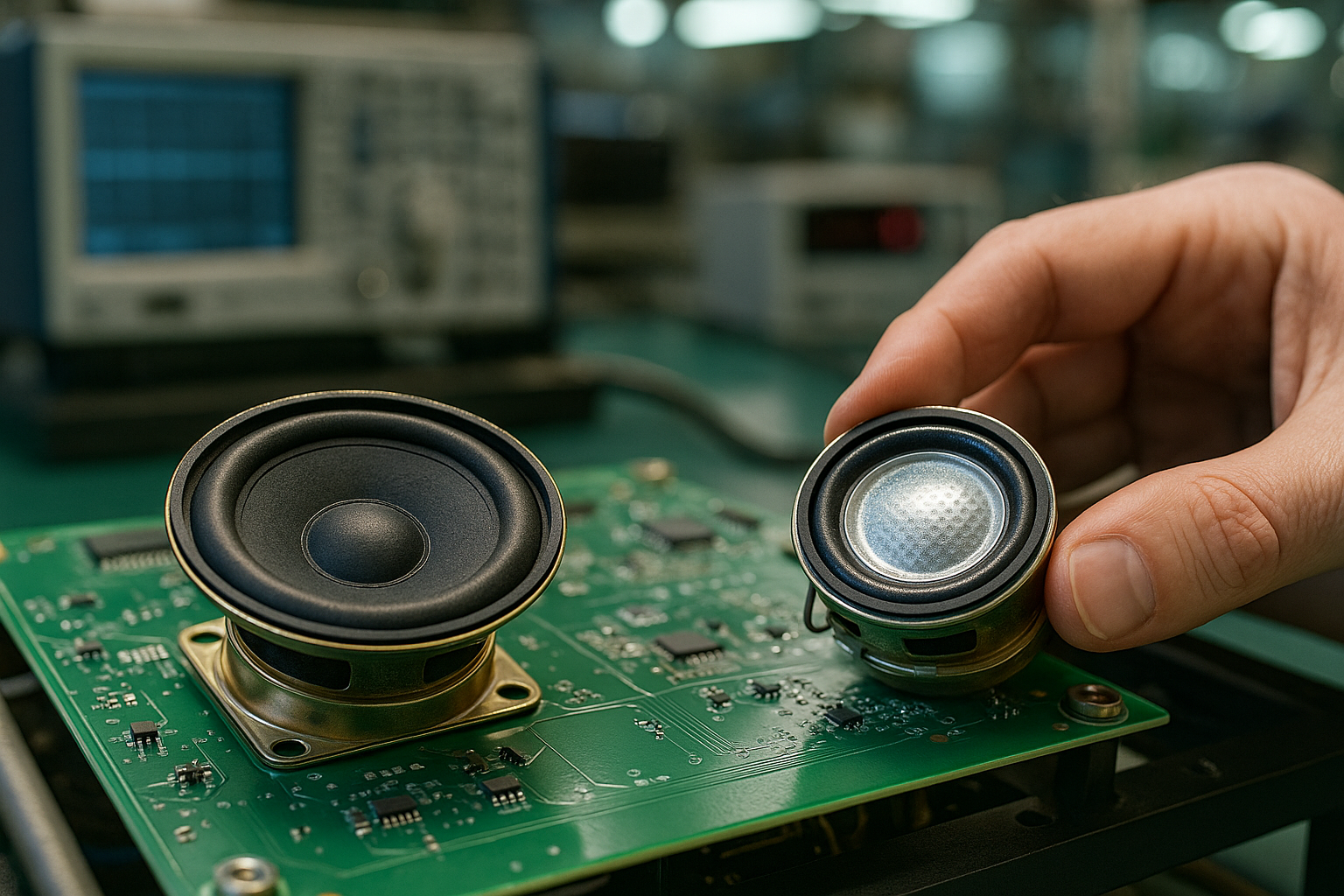
Regular speakers vs mylar speakers
For connected devices, the speaker choice is usually less about marketing and more about product constraints. A regular cone-style speaker and a mylar-film speaker can both work, but they behave differently when you care about water resistance, durability, acoustic output, enclosure volume, and BOM cost.
If you are planning an IoT device, appliance module, handheld controller, or audio accessory, the right choice depends on how much mechanical stress the product will see, how tight the enclosure is, and whether you need a speaker that can survive moisture, vibration, or repeated handling.
What changes in practice
A traditional speaker generally offers a more familiar acoustic profile and can be easier to source across a wide range of power levels and sizes. A mylar speaker uses a thin mylar diaphragm or film-based acoustic element, which can be attractive where compact size, light weight, and environmental resistance matter.
Neither option is automatically better. The tradeoff is usually between sound character, robustness, and integration effort.
| Decision factor | Regular speaker | Mylar speaker |
|---|---|---|
| Water resistance | Depends heavily on enclosure and sealing | Often easier to package for moisture tolerance |
| Durability | Can be solid, but more sensitive to dust and impact | Often chosen where ruggedness and flexibility matter |
| Sound quality | Usually broader and more familiar audio response | Can be adequate, but may be more limited depending on size |
| BOM cost | Varies by size and supplier, often competitive | May be cost-effective in compact designs |
| Integration | Standard engineering path | May simplify certain sealed or thin-product designs |
- Define target loudness and listening distance.
- Check enclosure volume and available mount depth.
- Decide whether water or dust exposure is a requirement.
- Estimate acceptable BOM impact.
- Confirm test plan for audio, vibration, and sealing.
When a regular speaker is the better fit
Choose a regular speaker when the product needs more predictable audio performance and the enclosure gives you enough room for a conventional acoustic design. This is often the safer option if voice clarity, music playback, or general sound quality matter more than extreme compactness.
It is also a good choice when your suppliers already have validated part numbers, acoustic test data, and proven assembly flow for the enclosure style you are building.
When a mylar speaker makes sense
Mylar-based designs can be attractive in compact or rugged products, especially where the housing needs to resist water splashes, dust, or repeated handling. Teams sometimes prefer them when the industrial design is tight and the acoustic requirement is functional rather than high fidelity.
That said, you should still validate the final acoustic output in the real enclosure. A speaker that looks good on paper can sound very different once it is mounted behind plastic, gasket material, or a sealed grille.
What product teams should verify before choosing
- Required sound pressure level and voice clarity.
- Available enclosure depth and front-grille area.
- Moisture, dust, or splash exposure targets.
- Vibration and drop-test requirements.
- Supplier lead time and consistency.
- Whether the speaker choice changes final assembly steps.
Manufacturing and BOM impact
Speaker decisions do not live in isolation. A cheaper part can increase engineering risk if it needs extra sealing, a different grille, or more tuning time. A slightly more expensive part can sometimes reduce rework and improve first-pass yield. In practice, the better choice is the one that gives you the lowest total system cost, not just the lowest unit price.
For hardware teams, the real question is whether the speaker helps you hit the product target without adding hidden cost in testing, tooling, or support.
Decision framework
If you need the safest all-around option for audio quality, start with the regular speaker path and validate fit, sound, and sealing. If your design is compact, exposed to moisture, or needs a lighter-weight acoustic module, a mylar speaker may be the better engineering compromise.
The best choice usually comes from an enclosure-level prototype, not from the component datasheet alone.
FAQ
Are mylar speakers always water resistant?
No. The material can help in moisture-tolerant designs, but the full assembly still needs proper sealing and validation.
Do regular speakers always sound better?
Not always, but they often provide more familiar and flexible acoustic behavior for product teams.
Should I choose based on BOM cost alone?
No. Total system cost, assembly effort, and reliability matter more than the raw component price.
Need help choosing?
If you are deciding between regular speakers and mylar speakers for a connected device, Futurezen or Shenzhen Futurezen Co. Ltd. can help you compare acoustic performance, enclosure constraints, sealing needs, and BOM tradeoffs before you commit to tooling.