
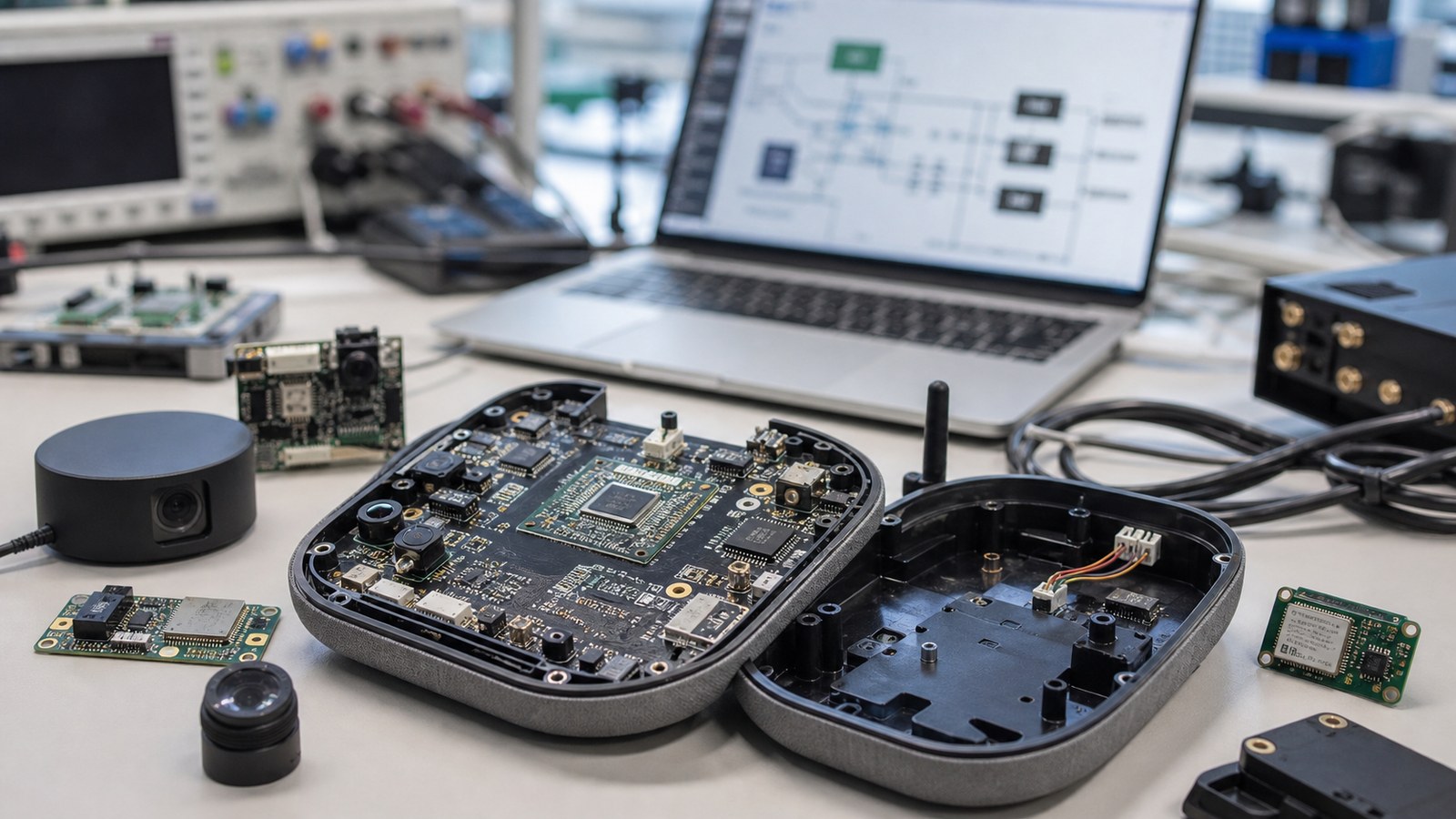
Adding an LLM to a product is not the same as adding a chatbot to a website. AI hardware product development has to connect model behavior with real-world hardware limits: processor performance, memory, power, thermal design, microphones, cameras, wireless connectivity, enclosure design, firmware updates, data privacy, certification planning, and manufacturing cost.
This is where many AI product ideas become more complicated than the first demo suggests. A prototype may work beautifully on a development board or laptop, then become painful when the team tries to put it into a real enclosure, run it on a smaller module, pass RF testing, keep heat under control, and ship it at a BOM cost that still leaves margin. The demo is not the product.
Most teams get the first question wrong. They ask, “Which model should we use?” too early. For an LLM integrated device, the better question is, “What should the product do locally, what should happen in the cloud, and what hardware architecture can survive production, certification, and support?”
AI Hardware Product Development Starts With the Use Case
Before choosing a processor, module, or AI accelerator, define the product experience clearly. LLM integration can mean very different things depending on the product, and those differences change the PCB, memory, camera, microphone, enclosure, wireless, certification, and factory test plan.
- A voice assistant that answers product-specific questions
- A camera device that explains what it sees
- A service robot or kiosk that follows natural-language instructions
- A POS or payment product that provides guided troubleshooting
- An industrial device that summarizes status, alarms, or maintenance steps
- A smart home product that combines voice control with local sensors
Each use case has different needs for latency, privacy, memory, battery life, wireless connectivity, audio, camera input, display output, and offline behavior. The hardware should follow the use case, not the other way around. When the chip is chosen first, the real cost often shows up later in redesigns, thermal fixes, module substitutions, or a product that cannot pass the tests required for its target market.
On-Device AI, Cloud AI, and the Real Cost of the Architecture
Most LLM-integrated hardware products fit into one of three architectures. None is automatically best. Cloud dependency is a user-experience decision, not just an architecture decision, and local AI is a cost and thermal decision, not just a privacy slogan.
| Architecture | Best Fit | Main Tradeoff |
|---|---|---|
| Cloud-first AI | Products that need larger models, frequent updates, and strong reasoning capability | Requires reliable connectivity and ongoing cloud cost planning |
| On-device AI | Products that need low latency, privacy, offline behavior, or reduced bandwidth | Limited by memory, compute, thermal design, and model size |
| Hybrid AI | Products that need fast local detection plus richer cloud intelligence | Requires clear handoff between firmware, edge inference, and cloud services |
For many commercial edge AI products, hybrid AI is the practical choice. A product may run wake-word detection, sensor filtering, simple commands, image pre-processing, or safety checks locally, then send a deliberate request to a cloud LLM for more advanced reasoning. That split is not glamorous, but it is often what keeps the product responsive, affordable, and realistic to manufacture.
LLM Hardware Design: The Blocks That Decide Whether the Product Works
LLM integration affects more than the main processor. A production-ready product may need several coordinated hardware blocks:
- Processor or smart module: controls the application, user interface, networking, and local AI workload.
- NPU, GPU, or AI accelerator: supports local inference where the product needs edge AI performance.
- Memory and storage: affects model size, context handling, firmware updates, logs, media, and local data retention.
- Microphones and audio path: needed for voice input, wake word, echo cancellation, and noisy environments.
- Camera or sensor input: required for multimodal AI, inspection, monitoring, or contextual awareness.
- Wireless connectivity: Wi-Fi, Bluetooth, 4G, or 5G can determine whether cloud AI feels reliable.
- Power and thermal design: AI workloads can change battery life, heat, enclosure requirements, and user comfort.
- Security elements: may be needed for credentials, OTA updates, payment products, or device identity.
The right hardware architecture depends on the workload. A small assistant with cloud processing may not need the same local compute as a vision device, robot, kiosk, or industrial AI terminal. In Shenzhen production planning, this is where teams often discover that the module price is not the real cost. Availability, firmware maturity, thermal behavior, certification history, and production test support can matter more than a cheaper line item in the BOM.
Connected AI Device Manufacturing Needs a Connectivity Plan
If the product depends on a cloud LLM, connectivity becomes part of the user experience. A weak network can make an AI product feel slow, inconsistent, or broken even when the electronics are working correctly. For connected AI device manufacturing, this needs to be decided before the enclosure, antenna position, module choice, and provisioning workflow are treated as finished.
Connected AI products should define:
- Whether the product uses Wi-Fi, Ethernet, Bluetooth, 4G, 5G, or a phone companion app
- What happens when the network is unavailable
- How much data the product sends and receives
- Whether a pre-installed SIM or managed connectivity plan is needed
- How logs, updates, and diagnostics will work in the field
For products that need out-of-box activation, such as payment devices, smart terminals, kiosks, field sensors, or AI service devices, 4G connectivity may be more reliable than asking every user to connect to Wi-Fi. That creates its own work: SIM or eSIM provisioning, antenna validation, data plan ownership, field testing, and sometimes different SKUs for different regions.
Privacy, Security, Certification, and Model Updates
LLM-integrated hardware should be designed with a model lifecycle, not just a launch model. AI behavior, prompts, firmware, local models, and cloud endpoints may change over time.
Important planning questions include:
- What data is processed locally, and what is sent to the cloud?
- How is user consent handled?
- Can firmware and model-related components be updated securely?
- How are API keys, certificates, and device credentials protected?
- What logs are stored for troubleshooting?
- How will the product behave if the AI service changes or becomes unavailable?
These decisions affect PCB design, storage, secure boot, factory provisioning, customer support, and long-term maintenance. They can also affect certification planning. A product with wireless connectivity, batteries, chargers, cameras, microphones, or payment-related use cases may need CE, RoHS, FCC, or industry-specific planning earlier than the software team expects.
BOM, Thermal, and Certification Planning for AI Hardware
AI hardware can become expensive quickly if the architecture is not constrained early. More compute can require more memory, larger storage, better power regulation, stronger thermal design, and a more expensive enclosure.
For commercial products, BOM optimization should compare the full system cost, not only the processor price. A lower-cost module may become expensive if it forces extra components, weak software support, poor thermal behavior, or difficult certification. A more capable smart module may reduce development time but increase unit cost. The right answer is rarely obvious from a spreadsheet alone.
The best choice depends on the product’s target volume, expected AI workload, launch timeline, certification needs, and acceptable cloud cost. During EVT, thermal surprises often appear in places that looked harmless during BOM review: a module under sustained uplink, a display enclosure with poor airflow, or a charger and wireless radio sharing a tight plastic housing. Fixing those after tooling starts is never fun.
Testing AI Hardware Before Production
AI product testing should include both normal electronics testing and AI experience testing.
- Boot time and response time
- Audio or camera performance in real environments
- Network failure and recovery behavior
- Power consumption during idle, listening, processing, transmitting, and update states
- Heat under sustained AI or connectivity workloads
- Firmware update and rollback behavior
- Factory provisioning of IDs, credentials, certificates, and cloud settings
- Certification-related checks for target markets, such as FCC, CE, RoHS, or payment-specific requirements where applicable
- Production test flow for microphones, speakers, cameras, wireless, display, buttons, and sensors
A polished AI demo is useful, but production readiness depends on whether the device can be built, tested, updated, and supported repeatedly.
AI Hardware Product Development Checklist
- Define the AI task, input types, response time, and offline behavior.
- Decide what runs on-device, what runs in the cloud, and what happens in a weak network.
- Choose hardware based on model size, memory, power, thermal, and software support.
- Plan microphones, cameras, displays, speakers, and enclosure design early.
- Review connectivity options, including Wi-Fi, Bluetooth, 4G, or 5G.
- Plan secure firmware updates, model updates, logging, and credentials.
- Identify certification requirements before enclosure, antenna, battery, charger, or payment-related decisions are locked.
- Optimize the BOM around performance, production volume, certification, and reliability.
- Build a test plan that covers both electronics and AI user experience.
How Emszen Can Help
Emszen supports electronics product development and manufacturing from Shenzhen, China. For AI hardware products, the team can help connect early product requirements with PCB design, module selection, enclosure and tooling considerations, BOM optimization, wireless planning, certification planning, testing, and volume manufacturing.
That connection matters because an LLM-integrated product is not only a software system. The user experience depends on the hardware platform, connectivity, power system, microphones, cameras, enclosure, factory provisioning, and production test plan. Emszen can also help teams think through practical compliance questions early, including FCC, CE, RoHS, and payment-device certification paths where they apply.
For buyers, the value is not just finding a factory after the design is finished. It is having manufacturing feedback while architecture choices are still flexible enough to change.
Building an AI Hardware Product?
If you are trying to decide whether your current module choice, cloud dependency, antenna plan, or BOM target will survive certification and production, that is exactly the conversation to have early. Send Emszen your product stage and the main decision you are stuck on, and we can help review the practical path from AI demo to manufacturable connected hardware.
FAQ
Can an LLM run directly on a hardware device?
Some smaller or optimized AI models can run on-device when the hardware has enough compute, memory, storage, and software support. Larger LLM workloads often use cloud processing or a hybrid approach.
Should AI hardware use cloud AI or on-device AI?
It depends on latency, privacy, power, model size, connectivity, and cost. Many products use a hybrid architecture: local wake word or sensor inference, then cloud AI for more advanced reasoning.
What hardware matters most for an LLM-integrated product?
The most important hardware choices are the processor or smart module, memory, storage, AI accelerator, connectivity, power design, thermal design, microphones, cameras, and secure update capability.
References
For a voluntary framework covering trustworthiness and risk management in AI systems, see the official NIST AI Risk Management Framework. Wireless implementation details should also be checked against the current Bluetooth SIG specifications.